
 Facebook
 X
X
 Pinterest
 Copy Link
Better Together Podcast — Luxury Financing Edition

Why Luxury Financing Is the Secret Weapon Coldwell Banker Agents Are Sleeping On
As a Field Marketing Specialist at Coldwell Banker, one of my favorite parts of this job is translating complex, high-value conversations into actionable insights that agents can actually use to win more business. Episode three of the Better Together Podcast did exactly that. And if you haven’t watched it yet, I’m going to make sure you don’t miss a single takeaway.
The episode is hosted by Lindsay Listanski, VP of Marketing at Coldwell Banker, alongside Dave Dicki, President and Chief Production Officer of Guaranteed Rate Affinity, and Kate Amore, EVP and Head of Product at Guaranteed Rate Affinity — making her first appearance on the podcast. Together, the three of them deliver one of the most agent-useful conversations I’ve come across in a long time, focused entirely on what luxury financing looks like in today’s market and how Coldwell Banker agents can use it to their advantage.
Let me break it all down for you.
What Is the Better Together Podcast and Why Should You Be Watching?
The Better Together Podcast is a joint production between Coldwell Banker Realty and Guaranteed Rate Affinity. It exists for one reason: to give Coldwell Banker agents a deeper understanding of the financing tools and partnership resources available to them and their clients.
Lindsay Listanski hosts each episode with a clear and intentional lens. Translating complex mortgage and financing topics into the kind of practical language agents can bring directly into listing appointments, buyer consultations, and client conversations. As she puts it, it’s the Coldwell Banker marketing team’s job to take what Guaranteed Rate Affinity offers and frame it as value agents can use to win.
This isn’t a generic mortgage podcast. This is your competitive edge, packaged into digestible episodes.
Episode three zeroes in on the luxury market. Jumbo loans, ultra-high-net-worth buyers, crypto-backed financing, and the kind of client experience that separates a trusted advisor from just another agent in the room.
Guaranteed Rate Affinity’s Role in the Luxury Lending Space
Here’s something that might surprise you: most people don’t associate an independent mortgage bank with luxury lending dominance. That assumption is costing agents opportunities.
Dave Dicki explained that Guaranteed Rate Affinity is one of the biggest players in what he calls “optionality”. Non-agency jumbo products, portfolio loans, and non-QM (non-qualified mortgage) solutions. When the market shifted hard in 2022 and liquidity dried up across the jumbo lending space, Guaranteed Rate Affinity was the first independent mortgage bank to return to jumbo lending through their own securitization product. While competitors were sitting on the sidelines, they were already back at the table.
That kind of leadership matters when you’re representing a luxury client and need a financing partner you can stake your reputation on.
Why This Matters at Your Next Listing Appointment
Lindsay framed this perfectly for agents during the episode. It’s worth repeating verbatim as a mindset shift. When you’re sitting at a listing appointment and you want to communicate the strength of your lending partnership, here are three things worth knowing and saying out loud:
- They’re the largest independent mortgage bank in the luxury lending space
- They were the first to return post-2022 market shift — showing both stability and boldness
- 94% of their clients said the mortgage process was easy — and in luxury, discretion and ease aren’t nice-to-haves, they’re deal-makers
That last stat is worth pausing on. 94%. Dave noted that this number is actually continuing to climb. It was sitting at 90% not long ago. In a category where clients are accustomed to white-glove service across every touchpoint, being able to say your lending partner makes the process easy is a genuine differentiator. Lindsay summed it up well: ease and discretion carry heavy weight with luxury clients.
Jumbo, Super Jumbo, and Beyond. What Agents Need to Know
Kate Amore broke down the loan tiers in a way that every agent working above the $1M price point should have memorized.
The Jumbo Loan Tiers Explained
- Jumbo loans start at $1.2 million. Yes, that threshold has moved, and it reflects today’s market reality
- Super Jumbo covers the $2.5 million to $5 million range
- In-house underwriting handles loans up to $10 million with all premium features intact. Assets as income, quick turn times, non-warrantable condo solutions
- Above $10 million options exist up to $30 million in select situations
Kate also dropped a stat that stopped Lindsay mid-conversation: 60% of buyers at the $10 million-plus price point are still purchasing in cash. Which means 40% still need financing. That’s not a small number. Those buyers need a lending partner with the infrastructure to handle their complexity.
Lindsay’s follow-up observation was sharp: not only do you have jumbo and super jumbo options, but the in-house underwriting capability for ultra-high-net-worth individuals is something most agents don’t even know exists. Knowing it does is the kind of detail that builds real credibility in a luxury listing conversation.
As a Coldwell Banker agent, you have access to that partner.
GRA vs. Private Banks. Understanding the Difference
Lindsay pushed Dave on a question many agents face in the room with luxury clients: when a buyer has their wealth at a private or depository bank that also offers financing, why would they look elsewhere?
Dave’s answer was straightforward. Private and wealth banks can be a solid option. And sometimes offer competitive rates, but they come with strings: pledging assets, freezing assets, or being required to liquidate part of a portfolio as a condition of the loan. That creates friction for clients who’ve spent years building their wealth picture carefully.
Where Guaranteed Rate Affinity stands out, Dave explained, is sheer breadth of products and solutions, a portfolio that simply dwarfs the competition, including other independent mortgage banks. Kate added important context here: roughly 40% of the products and programs GRA uses today didn’t even exist two to three years ago. That level of product innovation is a direct result of the work Kate has led since joining the team, and it means agents are working with a partner that is actively expanding what’s possible for complex clients.
The GRA Portfolio Product. Kate’s Favorite and Most Underutilized Tool
When Lindsay gave Kate the microphone and asked her to name the single most underutilized product in the GRA lineup, Kate didn’t hesitate: the GRA Portfolio Product Line.
Who Is This Product Built For?
This product was specifically designed for:
- Self-employed individuals whose tax returns don’t reflect their true income
- Business owners whose CPAs write down income aggressively
- Investors looking to qualify using assets or business cash flow
- Short-term rental buyers who want to use projected rental income to qualify
Kate’s framing was memorable: the product supports the American dream of building wealth while minimizing taxes. If your client has a CPA who does their job well, their tax returns may actually work against them in a traditional mortgage process. This product flips that dynamic. Letting buyers qualify for a larger luxury loan than they expected, using assets as income, business cash flow, or rental revenue streams instead.
How to Position This With Clients
This is the kind of product knowledge that moves you from being an agent to being a true advisor. When a self-employed buyer tells you they’re worried about qualifying, the answer isn’t “let’s look at less expensive homes.” The answer is “let me connect you with our lending partner. They’ve likely got a loan for that.”
That shift in positioning is powerful. It builds trust, keeps transactions alive, and sets you apart from every other agent who would have just shrugged.
RateFi — Financing for the Crypto-Wealthy Buyer
This was the moment in the episode that clearly excited Lindsay most. It’s the product I think agents are least prepared to talk about.
One in four adults in the United States now owns cryptocurrency. Of those, 42% are Gen Z and 36% are millennials. Crypto wealth is real, it’s growing, and it’s increasingly showing up in luxury real estate transactions.
The Problem With Crypto and Traditional Mortgages
Historically, using crypto toward a home purchase meant one of two things: liquidate it (triggering a capital gains event) or navigate an opaque, complicated lending process that required handing over control of your assets to a third party. Neither option is attractive to a sophisticated buyer. Lindsay noted that with recent changes at the government level, crypto is being increasingly normalized as an asset class. Which makes having a clean financing solution for it even more timely.
What RateFi Changes
Guaranteed Rate Affinity’s RateFi product was built to solve this problem directly. Here’s what makes it different:
- Clients keep their crypto. No forced liquidation, no capital gains event
- No requirement to hand over or freeze digital assets
- Borrowers qualify for their loan the same way they would with any other asset. Cleanly and without unnecessary friction
Kate described it as a common sense, easy, bespoke experience. And for a buyer whose wealth is tied to digital assets, that framing is everything.
As an agent, you don’t need to be a crypto expert. You just need to know this product exists and be able to say, “Our lending partner has a solution for that.” That sentence alone could be the difference between winning and losing a luxury buyer client.
The Bigger Picture. Being an Advisor, Not Just an Agent
Dave closed the episode with a distinction that Lindsay clearly appreciated, and one that applies just as much to real estate agents as it does to loan officers.
He drew a line between a mortgage consultant and a mortgage advisor. A consultant processes the transaction. An advisor understands the full picture, brings options to the table, and helps clients make decisions they feel confident about. The more time agents and loan officers spend together — not just on active deals, but proactively understanding the product landscape. The more naturally that advisor role shows up in every client conversation.
Lindsay closed the episode with a line that stuck with me: individual power on both sides, but together we bring collective strength. That’s exactly what this partnership is designed to do.
The First Move Dave and Kate Recommend
Both Dave and Kate gave the same essential advice for agents who want to start leveraging this partnership more strategically:
Spend time with your loan officer. Understand the product landscape together. Make a shared commitment to bring options into every client conversation. Even when you’re not sure they’ll be needed. The awareness you build in those conversations will show up in your listings, your negotiations, and your reputation.
Watch the Full Episode
I’m Phil Brown, Field Marketing Specialist at Coldwell Banker, and my job is to help agents find and use every competitive advantage available to them. The Better Together Podcast — hosted by Lindsay Listanski, VP of Marketing at Coldwell Banker — is exactly that: a resource built specifically for Coldwell Banker agents who want to go deeper on financing strategy and win more business in any market.
👉 Watch Episode 3 and the full Better Together Podcast playlist here: Better Together Podcast on YouTube
Coldwell Banker Social Media Mastermind Recap: What Every Real Estate Agent Needs to Hear Right Now
Coldwell Banker Social Media Mastermind Recap: Real Talk on Video, Authenticity, and Growing Your Business Online
There are moments in this work that genuinely stop you in your tracks. Not because of a big sale or a major campaign milestone, but because you watch someone you’ve worked alongside step into the spotlight and absolutely own it.
That’s exactly what happened at Coldwell Banker’s May Social Media Mastermind.
As a Field Marketing Specialist at Coldwell Banker, I spend a lot of my time helping agents unlock their potential online — coaching them on content, branding, tools, and strategy. So when Betsy Ronel, one of my Westchester agents, was invited to be the featured guest for this national mastermind, I won’t lie: I felt proud. Really proud. She has been putting in the work, showing up authentically, and building something real on social media, and watching her share that story with Coldwell Banker agents across the country was one of those genuinely rewarding moments in this job.
If you missed the session — or if you were there and want to revisit everything that was covered — this recap is for you. What followed was one of the most honest, practical, and motivating conversations about real estate social media marketing I’ve heard in a long time.
Who Was in the Room (or on the Screen)
The session was hosted by Coldwell Banker’s national social media team: Nicole Gladstone, representing the South; Tiffany Giles, representing the Midwest; and Arianna Berta, Social Media Specialist for the West Coast.
The featured guest was Betsy Ronel, a Coldwell Banker agent out of Northern Westchester, New York, who specializes in towns like Bedford, Pound Ridge, Katonah, Mount Kisco, North Salem, and South Salem. Betsy started her real estate career eight years ago, from scratch, in an area where she knew no one, with no referral network and no roots. She leaned into social media when other agents in her market weren’t, and it became the engine that built her business. Hearing her story again, in front of a national audience, reminded me exactly why we champion agents like her.
The Top Takeaways from the Session
1. Face-Forward Content Is the Highest-Performing Content You Can Create
This was Betsy’s number one answer when asked what consistently performs best, and it’s something the entire Coldwell Banker social media team echoed throughout the session.
People follow you. Not your infographics. Not your market stats. Not even your listings. They follow you because they like you, and they want to see your face.
Betsy put it memorably:
“Even Cindy Crawford doesn’t wake up looking like Cindy Crawford.”
Stop waiting until your hair is perfect or your lighting is right. Show up. Say what you have to say. That is the content that outperforms everything else, every time.
As a real estate marketing specialist, this is one of the single most important things I tell agents, and Betsy validated it beautifully: your humanity is your greatest competitive advantage online.
2. You Don’t Need to Spend Money to Win at Social Media
Betsy has been doing social media entirely on a budget of essentially zero, and she’s not apologetic about it.
Her toolkit:
- InShot (free) — video editing
- CapCut (free) — video editing
- Canva (free) — graphics and design
The Coldwell Banker social media team confirmed these are tools they use and recommend as well. The session also mentioned Edits, an Instagram-developed app similar to CapCut, which will be the subject of an upcoming workshop.
If you feel like you’re not tech-savvy enough to use these tools, Betsy’s advice was refreshingly direct: learn during your downtime, or find a college student who can show you the ropes for an hour. Either way, there’s no budget barrier standing between you and a strong social media presence.
3. The Biggest Mistake Agents Make Is Not Getting on Camera
When asked directly what the single biggest mistake real estate agents make on social media, Betsy didn’t hesitate: not getting in front of the camera.
She reframed it in a way that I think every agent needs to hear. You are not on social media to be judged on your appearance. You are there to establish your authority and give people information about your market. No one is looking at you the way you look at yourself. They’re watching because they want to know what you know.
“Take your agency and authority back,” she said. “We are advisors. We have a lot of information on our respective markets. Just start talking.”
Whether it’s a new restaurant that opened in town, an update on local market stats, or a quick open house walkthrough. Pick up your phone and start talking to it as if you’re talking to someone you love and trust. The discomfort fades fast, and the results compound over time.
4. Hook Them in Three Seconds or You’ve Lost Them
On video length and strategy, Betsy was equally direct: audiences today have a skip rate of anywhere from 40 to 50 percent, and if you don’t hook someone in the first three seconds, they’re gone.
Her advice: lead with your point. Think in soundbites. Hit hard right from the start, then go into the detail. For length, aim for under two minutes. Under one minute whenever possible.
Arianna from the social media team reinforced the science behind this: the first three seconds is when you either earn attention or lose it. Your opening line is not a warm-up, it’s a hook.
5. Posted Is Better Than Perfect — Just Post
The session’s most quoted theme, repeated by both Betsy and the Coldwell Banker social media team, was a simple one: just post.
Stop optimizing. Stop waiting for the perfect moment or the perfect caption or the perfect outfit. You’ll film 50 takes and no one will ever know. You’ll piece together the best parts of three different clips. That’s normal. That’s fine. No one sees your outtakes.
“If you can sell real estate and walk into a house with a stranger, you can put yourself out there on a video,” Betsy said. “It’s just that logical.”
On the question of timing — whether there are better days or hours to post — Betsy’s honest answer was that Instagram’s insights will show you your own personal best windows, but the priority is consistency and volume, not scheduling perfection. Post. That’s the move.
6. Your Content Mix Should Be Listings, Local, and Personal
When asked how she divides her content, Betsy’s approach was practical and refreshingly balanced:
- Just listed and just sold posts
- Open house announcements
- Buyer tours
- Local happenings — coffee shops, restaurants, events, day trips
- Personal moments — birthdays, family milestones, what’s happening in her life
She offered a smart strategy for agents going through a dry spell with no listings of their own: ask a colleague in your office if you can post their listing. Credit them in the caption (legally required in many markets, including Westchester), and you keep showing up in your audience’s feed as an active, engaged agent.
If you have no listings and no content, go film local. Take a day trip within an hour of your market. Batch the content and dip into it throughout the week. Something is always better than nothing.
7. Carousels Are Now Neck and Neck with Video
One of the most significant platform updates shared during the session came from Emma Ramirez, who noted that carousels — multi-image posts you swipe through — are now performing on par with video in the algorithm.
Here’s why that matters: every swipe on a carousel counts as a view. So a six-image carousel that keeps someone engaged through all six images registers as six views on a single post. For agents who are not yet comfortable on camera, this is a powerful entry point. Start in Canva, pull from the content drops the CB social media team provides, and build out your carousel game while you work up to video.
The algorithms are constantly changing, which is exactly why the monthly mastermind format exists. To keep agents ahead of what’s shifting.
8. Forget Follower Count. Focus on Authentic Reach.
Betsy was characteristically blunt about buying followers: don’t do it. The algorithm is onto it, and inflated follower counts with low engagement hurt your reach more than they help your image.
Instagram recently conducted a major cleanup of bot accounts precisely because fake followers distort the engagement signal. If you have 20,000 followers but two likes per post, the platform flags you and reduces your organic reach. A clean account with 2,000 real, engaged followers will outperform a fake-inflated account every time.
Her approach: follow accounts that bring her joy or intellectual curiosity, engage authentically, and let her follower count be a byproduct of good content rather than a goal in itself.
9. Social Media Is Always Working for You — Even When You’re Not
One of the most valuable reframes of the entire session came near the end of the Betsy conversation, and it’s something I repeat to agents constantly as a real estate marketing specialist.
Social media is not just about generating direct leads. It’s about establishing presence, building credibility, and influencing where you show up when someone Googles your name or searches for agents in your area. People are watching you even when you don’t know they’re watching. They’re doing their research before they ever reach out.
“It’s like an investment account,” Betsy said. “It’s always making money for you.”
Your social media presence works while you sleep, between listing appointments, during the slow months. If you treat it as a holistic part of your marketing ecosystem rather than a direct-response channel, the numbers start to make a lot more sense.
10. The Podcast Play: When Your Personal Brand Extends Beyond Real Estate
A significant portion of the session was devoted to Betsy’s podcast, Heavens to Betsy! — a personal, lifestyle-focused show that has nothing to do with real estate on the surface, and everything to do with it in practice.
Betsy didn’t launch it to generate leads. She launched it because a producer who believed in her voice gave her a push, and because she needed a creative outlet that was entirely her own. What happened organically is that the authentic connection she built through the podcast. With local guests, with listeners, with people who would never have found her through a listing alert, translated into real estate business.
The lesson is bigger than podcasting: when you show up as your full, real self in any medium, you attract people who like you. And people who like you call you when they need a real estate agent.
For agents looking for a model of what storytelling-driven content can look like, the team also highlighted Connor Jorgensen (@homesutah), a Coldwell Banker agent out of Utah whose reels use property storytelling and agent collaborations as the foundation for his content. Worth a follow.
11. Coldwell Banker Tools Are Underused and Underrated
Betsy, who has been at three brokerages, was candid about this: she thinks Coldwell Banker’s tools are outstanding, and she uses them. Including Prospect Square for newsletters and the CB CRM. Her only marketing expense is essentially zero because the platform provides what she needs.
For agents who aren’t yet fully tapped into the Coldwell Banker ecosystem, this is worth paying attention to. Tools like Prospect Square make it easy to distribute market stats, personalized newsletters, and branded content without needing an outside vendor.
On the Compass/Coldwell Banker merger and tech integration, Betsy’s take was optimistic, and honest, given she has worked at Compass before: the combination of CB’s branding and tools with Compass’s intuitive tech platform is shaping up to be something genuinely exciting for agents. The rollout is close, and it’s worth watching.
Closing Thoughts: Why Sessions Like This Matter
I’ve been doing this work long enough to know that the gap between agents who succeed at social media and agents who don’t usually isn’t tools, budget, or even talent. It’s courage and consistency.
What Betsy Ronel modeled for every agent in that room, and what the Coldwell Banker social media team reinforces month after month in these masterminds, is that showing up as yourself, repeatedly, generously, and without overthinking it, is the strategy. Everything else is a tactic.
Watching Betsy hold her own in front of a national audience, speaking the same truths I’ve been sharing with agents in Westchester and beyond, was genuinely one of the highlights of my month. She has earned every bit of that spotlight.
If you’re a Coldwell Banker agent and you’re not attending these monthly masterminds, start. The level of practical, current, actionable guidance you’ll walk away with is hard to find anywhere else.
📅 Ready to Talk Real Estate Marketing Strategy?
As a Field Marketing Specialist at Coldwell Banker, I work directly with agents to build the kind of social media presence that generates real results. If you want to talk about your current approach and where to take it next, let’s connect.
How to Build Your Digital Book: What Real Estate Agents Need to Know About Online Authority

Why This Presentation
Meant Something to Me
I almost did not get to be in that room.
There are over 80 Field Marketing Specialists across Coldwell Banker Realty. When I joined the company, I was not eager to launch a social media presence. After a decade running marketing for luxury real estate brands — first at a Sotheby's International Realty affiliate in the Caribbean for ten years, then at The Corcoran Group in Miami — I was, honestly, burned out on it.
But a few months into my role covering North Jersey and Westchester, I realized something uncomfortable: my own agents barely knew who I was. I was showing up, doing the work, sending emails — and getting nothing back. So I gave in. I built a presence. I posted consistently. I leaned into the exact strategy I am about to teach you.
"If I'm gonna do this, let's go all in. It was the only way I could get attention from agents. My emails weren't getting read — but suddenly people were responding to everything I posted on Instagram."
— Phil Brown, Field Marketing Specialist at Coldwell Banker RealtyThat strategy worked. Linda Dickinson, the Coldwell Banker manager who invited me to present to her Haddonfield and Moorestown offices, did not find me through a company directory. She found me online — through my content, because I had built my book. The fact that the method I was about to teach had directly put me in that room was not lost on anyone in the audience.
That is not a coincidence. That is proof of concept. And it is exactly why everything in this post matters.
Think of Yourself as a
Book in a Digital Library
The mental model I use with every agent I work with starts here. Imagine a digital library open 24 hours a day, 7 days a week. Every potential buyer and seller in your market walks in every day and asks the librarian to recommend someone. The librarian has access to every book on the shelf — and your job is to make yours the most complete one there.
Right now, most agents — and I say this respectfully, because it is true in every market I work in — are pamphlets. They exist. They can be found if someone searches specifically for their name. But the moment someone walks in with a general question, the pamphlet gets passed over for the fuller book sitting next to it.
25 years of experience. Still the first place most people start their search. Optimizing your Google presence — Business Profile, website keywords, consistent posting — is the foundation everything else is built on.
If your footprint is strong here, you show up in results, your profile looks authoritative, and local clients find you before they find anyone else.
Experience vs.
Evidence
This comparison tends to land with agents immediately. Two agents. Different levels of experience. Completely different digital footprints.
- Google Business Profile: 14 reviews, last updated 8 months ago, no keyword description, 3 photos
- Instagram: 287 followers, last posted 6 weeks ago, bio reads "Realtor helping families find their dream home" — no location
- YouTube: No channel
"The librarian cannot recommend what it cannot find."
Agent B is not a better agent. But in a digital library, proof beats experience every time. The good news? Most agents in Haddonfield, Moorestown, and across South Jersey have not figured this out yet — their books are thin. That means the window to build something your competition does not have is wide open right now.
SEO, AEO, and GEO —
You Don't Need to Master All Three Today
As a Field Marketing Specialist at Coldwell Banker, one of the things I emphasize with agents is that online visibility works at three levels of sophistication. You do not need to understand the technical mechanics — you just need to understand how to feed them. Consistent, keyword-rich, locally specific content is the strategy for all three.
Search Engine Optimization
Someone searches "real estate agent Haddonfield NJ" and you show up. Keywords on your website, Google Business Profile, social bios, and posts all contribute. This is the baseline — and it is absolutely worth getting right first.
The foundation
Answer Engine Optimization
A client asks a specific question — "Who is the best agent for first-time buyers in Moorestown?" — and AI recommends you by name. This happens when you have enough content directly answering what your ideal clients are asking. One answer. One name. Yours.
The next level
Google Business Profile —
The Cover of Your Book
If someone searches for you on Google and lands on your profile, what do they see? An empty profile with three photos and a generic bio is the equivalent of a book with a blank cover. People judge it. They move on.
Here are the four layers that matter most — think of each one as a different feature of your cover and inside pages.
Category & Description
Your book's cover. Include your location keywords, specialty, and years of experience. "Haddonfield and Moorestown real estate agent specializing in first-time buyers" does more work than any generic bio.
Reviews
Reader testimonials. Ask clients to mention where they were located and what you helped them accomplish. The more neighborhood-specific, the more powerful as a ranking signal.
Weekly Posts
Post at minimum once a week — a listing, a market insight, a client question answered. Google sees your book being actively written. Go quiet for months, and Google assumes you've gone out of business.
Photos
Illustrations that make your book feel real and local. Update them regularly. They signal active business and give potential clients a tangible sense of who you are and where you work.
Your Clients Are Handing You
Your Content Calendar Every Day
The most common question I get from agents: What do I even post about? The answer is sitting in your inbox, in your phone calls, and in every client conversation you have. Every question a client asks you is a page waiting to be written.
Should I waive the inspection contingency? That is a page. What does days on market mean in South Jersey? That is a page. What is it like to live in Moorestown versus Cherry Hill? That is a page.
"Act as a content strategist for a real estate agent in Haddonfield and Moorestown, New Jersey. I will give you one client question. Answer it and turn it into: a 30-second Instagram Reel script, a Google Business Profile post, a YouTube video outline, a LinkedIn insight post, and a short email to my database. Keep everything specific to South Jersey and my local market. Prioritize clarity, authority, and local keywords. Avoid generic advice. Here is my client question: [PASTE HERE]"
Run this in Copilot, ChatGPT, or any AI tool. One question becomes five pieces of content — all keyword-rich, all locally specific, all adding pages to your book.
During the live demo at the Haddonfield presentation, I ran the question "What is the inspection process in New Jersey?" through this prompt in real time. In under two minutes, we had a 30-second Reel script that opened with "Buying a home in Haddonfield or Moorestown? Don't skip this step" — a hook that immediately signals location, authority, and relevance to any algorithm indexing the content.
AI is not replacing your expertise. It is helping you get what you already know out of your head and onto the internet, where it can work for you around the clock.

Phil Brown
Real Estate Marketing Specialist · Coldwell Banker Realty
A decade of real estate marketing across three countries, two coasts, and every platform that matters — now channeled into helping Coldwell Banker agents in New Jersey and New York show up with clarity, confidence, and content that actually works. Phil covers 19 offices across NJ and NY, building AI-powered tools and running workshops that make complex marketing strategy feel genuinely achievable.
What the 2026 Home Shopping Season Report Means for Your Real Estate Marketing Right Now

What the 2026 Home Shopping Season Report Means for Your Real Estate Marketing Right Now
Every spring, agents ask the same question: Is this the year the market finally opens back up?
This year, Coldwell Banker just answered it — with data.
The 2026 Home Shopping Season Report surveyed more than 700 real estate agents nationwide to capture a real-time pulse on buyer and seller behavior this spring. The findings are packed with insight. But raw data isn’t enough. What matters is what you do with it — how you use it to sharpen your messaging, position yourself as the local expert, and connect with clients who are ready to move.
As a Real Estate Marketing Specialist at Coldwell Banker, I read through the full report and pulled out the five trends every agent should be paying attention to — along with exactly how to use each one in your marketing.
The 2026 Spring Market Is Moving — and Your Marketing Should Be Too
Forty-three percent of agents surveyed say this spring is busier than last year. That’s not a minor uptick — that’s a signal worth acting on. The market is shifting, and the agents who communicate that shift clearly and confidently are the ones who will capture attention right now.
This report gives you that credibility. Let’s break down each trend and what it means for your strategy.
Trend #1 — The Rate Lock-In Effect Is Starting to Loosen
What the Data Says
One of the most significant findings in the 2026 report: 35% of sellers currently working with Coldwell Banker affiliated agents have mortgage rates below 5% — and they’re still planning to sell this spring. Additionally, 39% of agents say the lock-in effect is no longer a meaningful factor in seller decisions, or only a minor one.
That said, 61% of agents still report it as a major or moderate factor. So this isn’t a resolved issue — it’s an evolving one, and that evolution creates a window of opportunity.
What This Means for Your Marketing
If you’ve been waiting for sellers to “come back,” some of them already have. The message that works right now isn’t about rates — it’s about circumstances. Life doesn’t wait for perfect market conditions. Sellers are listing because they need to, not because the numbers are ideal.
Your listing-focused content should lead with empathy and life transitions: relocation, growing families, downsizing, job changes. That’s the real motivator. If your marketing is still anchored to “wait for rates to drop,” you’re speaking to the wrong emotion.
Marketing action: Create a short-form video or carousel post addressing the “I’m locked in at 3% — should I still sell?” question directly. Lead with compassion, not market logic. This is one of the most Googled questions in real estate right now.
Trend #2 — “Comeback Buyers” Are Re-Entering the Market
What the Data Says
Seventy-seven percent of agents say they are currently working with buyers who stepped away from the market in the last two years and are now re-entering. These “comeback buyers” represent approximately 20% of all active homebuyers right now. Most of them (75%) are returning with a similar budget to when they first looked, while 24% have actually increased their buying power.
What This Means for Your Marketing
This is one of the most powerful audience segments you can speak to right now — and most agents aren’t addressing them specifically. Comeback buyers are emotionally invested. They’ve already been through the process. They’re motivated. And they may be in your database right now, sitting dormant.
This is a reactivation opportunity hiding in plain sight.
Marketing action: Pull your database from the last 18–24 months and segment out leads who went cold. Send them a “The market has changed since we last spoke” email or DM referencing that now may be the right moment to re-engage. This is not a mass blast — it’s a personal, data-informed touchpoint. Pair it with a market update post that speaks directly to the “I looked before and stepped back” buyer.
Trend #3 — Buyers Aren’t Waiting for Rates to Drop
What the Data Says
This one might surprise you: 80% of agents say their buyers are actively in the market and not holding out for lower mortgage rates or better conditions. Only 20% of buyers are in a “wait and see” posture this spring. In the Northeast, active buyer activity is especially strong.
What This Means for Your Marketing
If you’ve been crafting content around “when rates drop, buyers will move” — that narrative is largely outdated. The majority of serious buyers have already moved past rates as a barrier. They want homes. They want guidance. They want an agent who understands the current reality.
Your buyer-focused content should reflect urgency without pressure. The message isn’t “hurry before rates go up.” The message is “serious buyers are already out there — are you positioning yourself in front of them?”
Marketing action: Update your buyer-facing content to stop leading with rate predictions. Instead, lead with what active buyers need: guidance on negotiation, how to evaluate homes in a competitive local market, and the value of working with a knowledgeable agent who understands 2026 market conditions specifically. Use this data point as a hook: “80% of today’s buyers aren’t waiting — are you ready for them?”
Trend #4 — Climate Risk Is Becoming a Real Buying Factor
What the Data Says
Thirty-one percent of agents nationally say climate-related concerns — including wildfire risk, flood zones, hurricane exposure, and rising home insurance costs — are playing a bigger role in buyer decisions compared to just one year ago. That number rises to 35% in the South and 39% in the West.
What This Means for Your Marketing
This is a trend most agents are not yet talking about in their content — which makes it a significant opportunity to stand out as a knowledgeable, forward-thinking resource. Buyers are doing this research with or without you. If you become the agent who speaks to it clearly and honestly, you become invaluable.
You don’t have to be an insurance expert or a climate scientist. You simply need to be the person who acknowledges it, knows where to point clients for reliable information, and helps them think through these factors as part of their decision-making process.
Marketing action: If you work in a market with notable climate risk exposure, consider writing or recording a short piece on “What buyers should know about insurance costs and climate risk when purchasing a home in [your market].” This is highly searchable, locally specific, and positions you as a trusted resource rather than just a salesperson. It’s also exactly the kind of content AI search engines surface when buyers are asking these questions.
Trend #5 — The Regional Market Divide Is the Deepest It’s Been in Decades
What the Data Says
This may be the most structurally important finding in the entire report. The U.S. housing market is no longer moving as one — it’s fractured along regional lines in a way that hasn’t been seen since before the Global Financial Crisis.
- Midwest: 70% of agents describe their market as a seller’s market
- Northeast: 74% of agents describe their market as a seller’s market
- South: 56% of agents describe it as a buyer’s market
- West: 46% of agents describe it as a buyer’s market
Nationally, only 25% of agents say their local market is balanced.
What This Means for Your Marketing
National real estate headlines are almost useless to your clients right now. Agents who win in 2026 are the ones who localize the data — who take the national story and translate it for their specific ZIP code, neighborhood, or city.
If you’re in a seller’s market, your content should be showing sellers why now is a strong time to list, backed by local data. If you’re in a buyer’s market, your content should be empowering buyers with the message that they have negotiating power that hasn’t existed in years.
Either way, generic content is a missed opportunity. Hyper-local content built on real data is what gets agents remembered, shared, and referred.
Marketing action: Pull your local market stats (days on market, list-to-sale ratio, inventory levels) and pair them with the regional finding from this report. A post that says “Nationally, markets are split — here’s exactly what’s happening in [Your City]” is instantly more valuable than anything a buyer or seller could find from a national source.
How to Use This Report Across Your Marketing Channels
Data this rich deserves more than one post. Here’s how to stretch it across your content calendar:
Social Media
Break each trend into its own post — that’s five pieces of content from a single source. Use the data point as your hook, then add your local interpretation. “1 in 3 sellers is giving up a rate below 5% — here’s what I’m seeing from sellers in [Your Market].”
Email Newsletter
Send a market update email to your database with a subject line like: “I just read Coldwell Banker’s 2026 Housing Report — here’s what it means for you.” Personalize it by speaking directly to buyers and sellers separately if you have segmented lists.
Video Content
A 3–5 minute breakdown video of the five trends, filmed in your car or at your desk, creates instant authority. You’re not reading the report at them — you’re interpreting it as a local expert. That’s the difference between being informative and being indispensable.
Lead Conversations
When a prospect asks “how’s the market?” — this report is your answer. You’re not guessing. You’re pulling from a survey of 700+ agents and layering in local context. That’s a different level of credibility.
Bottom Line for Real Estate Agents This Spring
The 2026 Home Shopping Season Report from Coldwell Banker makes one thing clear: the market is moving. Sellers are letting go of historic rates. Buyers who stepped away are coming back. And the agents who show up with clear, confident, data-informed communication are the ones who are going to win this season.
Don’t let the data sit on a blog somewhere. Put it to work.
What to Read Next:
Sources for this Article:
- “2026 Home Shopping Season Report” from Coldwell Banker blog post
- Optionally link to a credible source on climate risk in real estate (e.g., First Street Foundation or a national publication)
Niche Real Estate Marketing: How to Sell a Unique Property to the Exact Right Buyer

Niche Real Estate Marketing: How to Sell a Unique Property to the Exact Right Buyer
Most listings follow a predictable path: professional photos, MLS syndication, open house, sold. That process works beautifully for properties that appeal to a broad audience. But what happens when your listing is not for everyone — when it has a feature so specialized, so unusual, so extraordinary that the average buyer doesn’t just fail to see value in it, but actually sees it as a problem?
That’s when niche real estate marketing becomes not just an option — it becomes the only strategy that makes sense.
In this post, I’m going to walk you through exactly what niche property marketing is, when you need it, and the step-by-step approach that top agents use to find the right buyer for the most unconventional listings on the market.
What Is Niche Real Estate Marketing?
Niche real estate marketing is the practice of deliberately targeting a narrow, well-defined segment of buyers, rather than broadcasting a listing to the widest possible audience. Instead of hoping the right buyer stumbles across your MLS entry, you identify who that buyer is, where they spend their time, and how to put your listing directly in front of them.
In real estate, a niche involves targeting a specific audience and catering to their unique needs and preferences. It helps to tailor your marketing efforts to a specific audience, strengthening your reach while also reducing competition by making you stand out from others in the field.
For most properties, casting a wide net makes sense. But for a listing with a feature that only resonates with a specific type of person, a 12-car garage, a working equestrian barn, a 2-acre greenhouse, a full recording studio — mass-market exposure is actually working against you. The wrong buyers tour, fail to connect with the vision, and move on. Meanwhile, the right buyer — the one who would recognize the property as a dream come true — never even knew it existed.
Niche real estate marketing closes that gap. It’s not about selling less. It’s about selling smarter.
When Does a Listing Need a Niche Marketing Strategy?
Not every listing requires niche marketing. The standard playbook works well when a property appeals to a wide demographic: the move-up family, the first-time buyer, the downsizer. But several clear signs indicate that a property has stepped into niche territory.
Signs Your Listing Has a Niche Audience
- The property’s most impressive feature will only excite a specific type of person. If the garage, workshop, horse facility, commercial-grade kitchen, or recording studio is the headline feature, that feature has an audience — but it’s not a general one.
- Buyers who tour it like it, but can’t figure out what to do with it. This is one of the most common signals. It means the property is being shown to the wrong people. They appreciate the quality but can’t see themselves using the space.
- Initial showings are strong, but the pipeline goes quiet. Early activity driven by standard MLS exposure fades fast because the general buyer pool doesn’t contain many ideal prospects for this specific listing.
- The property falls into multiple use categories at once. A residentially zoned building that could serve as a home, a small business headquarters, a multi-generational living situation, or a collector’s compound doesn’t fit neatly into one box — and standard marketing can’t capture that complexity.
If two or more of these are true for one of your listings, it’s time to shift from general marketing to intentional, niche-focused strategy.
Step 1: Identify Who Actually Wants This Property
This is the most important step, and where most agents stop too soon. The instinct is to describe the property and let buyers self-select. But for niche listings, you need to flip that model. You need to go find the buyer rather than waiting for the buyer to find you.
Think Beyond the Typical Buyer Profile
Start by asking a simple but powerful question: Who would walk into this property and immediately feel like it was built for them?
The most powerful real estate niches combine who the person is, where they are, and what specific problem or desire they have that this property solves.
For a property with a massive custom garage and workshop, the answer to that question might include: car collectors, custom builders, landscaping company owners, contractors who work from home, attorneys or professionals who need a private office with a separate entrance, or multi-generational families looking for independence within one property.
Each of those is a different person, with a different reason to love the home, on a different platform, in a different community. Your marketing strategy needs to speak to each of them individually, not with one generic listing description.
Use Data to Find Your Niche Audience
Once you know who you’re looking for, the next challenge is finding them. This is where data tools can be transformative.
Platforms like WealthEngine allow agents to filter high-net-worth individuals by specific lifestyle indicators, such as the number of vehicles registered in their name, luxury brand affiliations, or wealth tiers. If you’re marketing a property suited for a serious car collector, you can pull a list of people in your region who own six or more vehicles. That list may be small, potentially in the hundreds, but that’s exactly the point. A hyper-targeted list of 400 qualified prospects is worth more than a mass broadcast to 40,000 unqualified ones.
Success in niche real estate markets often depends on building strong networks, understanding client needs deeply, and leveraging marketing strategies that resonate with the target audience. Developing a Unique Value Proposition is key, it distinguishes you in a competitive market and attracts clients best suited to your specialized knowledge.
Step 2: Reframe the Listing’s Story Around the Right Buyer
Here’s where great real estate marketing becomes great storytelling. A niche listing has a narrative, you just need to find it, name it, and own it.
Lead With the Lifestyle, Not the Square Footage
Standard listing descriptions lead with bedrooms, bathrooms, and square footage. That format is designed to help buyers compare properties apples to apples. But when your listing exists in a category of one, comparison marketing doesn’t serve you. You’re not competing with other listings, you’re inviting the right person into a life they haven’t imagined yet.
When designing your marketing collateral and messages, think about selling a lifestyle, not just a listing.
A tagline like “Where your car collection lives as well as you do” works precisely because it doesn’t describe the property — it describes the buyer’s identity. It says: If this resonates with you, this house was built for you. That’s niche marketing in its purest form.
When you’re writing listing copy for a niche property, ask yourself: What does this buyer’s ideal day look like inside this home? What problem does this property solve that no other listing on the market solves? What would they brag to their friends about? Lead with that.
What “Intentional Selling” Really Means
Intentional selling is a mindset every agent should bring to every listing, but it’s absolutely essential for niche properties. It means recognizing that the right transaction isn’t just the highest price, it’s the right buyer, in the right timeline, with the right terms for your seller.
For a property with a highly specific appeal, pursuing the wrong buyer profile wastes time, energy, and market momentum. The seller who trusts you with an unusual listing deserves a strategy as unusual as the home itself, not a copy-paste approach borrowed from a standard playbook.
This means being willing to pause traditional outreach, think deeply about who the ideal buyer actually is, and build every marketing touch around that person.
Step 3: Go Where Your Niche Audience Already Is
Once you know who you’re looking for and what story you’re telling, the next step is getting in front of that audience on their turf.
Niche Publications and Platforms
General real estate portals are designed for general buyers. For niche listings, you need to expand your media mix to include channels where your specific buyer already goes to indulge their passion.
Meeting your target market where they already spend time is critical. Boat and RV owners gather at marinas, storage facilities, and hobby clubs. Affluent communities socialize at golf and tennis clubs, yacht clubs, and charity galas.
For a car enthusiast property, that means platforms like Hemmings (the leading automotive enthusiast publication), specialty car forums and communities, auction house newsletters, and automotive lifestyle media. For an equestrian property, it might mean horse show programs, agricultural publications, or breed association newsletters. For a property suited to a craftsperson or builder, trade publications and professional association networks become your media plan.
This is a different kind of media buy, often less expensive, far more targeted, and dramatically more likely to produce qualified inquiries.
LinkedIn and Targeted Paid Advertising
LinkedIn is frequently overlooked in residential real estate, but for niche listings targeting professionals, executives, business owners, contractors, attorneys, it deserves serious consideration. LinkedIn’s targeting allows you to reach people by industry, job title, company size, and geography, making it a powerful channel for a property that could double as a home office, executive retreat, or private workspace.
Advertising on platforms like Facebook and Google allows for precise targeting of your niche market by demographics, interests, and behaviors. Targeted online advertising is crucial for reaching luxury buyers in the real estate market.
Facebook also deserves a place in the mix, particularly for reaching an older, established wealth demographic. While Instagram skews younger, Facebook’s user base often includes the exact high-net-worth buyers who have both the means and the motivation for a truly unique property.
The goal isn’t to be everywhere. It’s to be exactly where your buyer is, with a message that speaks directly to their lifestyle.
Event-Based Marketing for Unique Properties
For properties with a strong lifestyle angle, an experiential marketing event can be the most powerful tool in your entire strategy. Rather than inviting the general public to a standard open house, consider hosting a curated VIP event designed specifically for your niche audience.
For a collector’s property with extraordinary garage space, this could mean inviting the short list of high-net-worth prospects — identified through your data research — to a private event where they bring their vehicles to the property. Let them feel what it would be like to own that space. Let the property do the selling.
This approach works for several reasons. First, it filters out looky-loos. Second, it creates genuine emotional connection between the prospect and the home. Third, it generates social media content organically — a property full of beautiful vehicles or extraordinary collections photographs itself. And fourth, it gives you a hook for PR outreach: a compelling event at an unusual property is a story, and local journalists covering luxury real estate, lifestyle, or automotive culture may be very interested in covering it.
Partnering with luxury car brands, interior designers, or fine dining establishments to create exclusive client experiences enhances your credibility and makes your marketing more memorable.
When planning a VIP event for a niche listing, coordinate with your luxury team — resources like Coldwell Banker’s Global Luxury division can provide additional reach, event support, and access to their broader network of qualified buyers and brokers.
Step 4: Create Content That Speaks Their Language
Marketing a niche property is fundamentally a content problem. The right buyer is out there, but they need to see this property in a context that makes sense to them, not in the standard real estate format they scroll past every day.
Authentic Video Beats Polished Ads for Niche Audiences
One of the most important shifts in real estate content marketing is the move toward authenticity. Polished, cinematic listing videos are valuable and have their place, especially in the luxury market. But for driving engagement from a niche audience, raw authenticity often outperforms high production value.
A 30-second vertical video of you walking through that one-of-a-kind garage, talking off the cuff about what makes it extraordinary, will resonate more deeply with a car enthusiast scrolling Instagram than a beautifully edited walkthrough that looks like every other luxury listing video. The enthusiast doesn’t want a brochure. They want to feel the space.
Niche buyers are passionate people. They recognize genuine enthusiasm immediately — and they respond to it. If you’re excited about what makes this property special, let that excitement show. That’s not unprofessional. That’s the most effective marketing you can do.
Short, authentic, vertical video for Instagram and Facebook Reels. Behind-the-scenes tours. “Did you know this property has…” hooks. These are the formats that reach new audiences organically, and that give social media algorithms enough engagement to push your content further into the feed.
PR and Media Outreach
For truly exceptional properties, earned media — press coverage — can reach audiences no paid campaign can access. A feature in a regional newspaper, a local magazine, or a specialty publication like a luxury automotive journal puts your listing in front of exactly the right reader with the credibility of editorial coverage.
Don’t be afraid to pitch a story. Journalists who cover real estate, architecture, or lifestyle are always looking for properties that are genuinely interesting. A home with a custom 12-car garage and workshop, residentially zoned for a home-based professional, in a luxury market — that is a story. Find the writer. Send them a few compelling photos. Tell them what makes it unusual.
The worst they can say is no. And if they say yes, you’ve just reached an audience of thousands of qualified readers with a level of trust that no advertisement can buy.
Step 5: Measure, Adjust, and Stay Intentional
Niche marketing requires a different success metric than standard listing marketing. With a general listing, you measure success by the number of showings, offers, and days on market relative to your area’s average. With a niche listing, none of those metrics apply in the same way.
You’re not looking for volume. You’re looking for fit.
Track which channels are producing qualified inquiries, not just any inquiries. A hundred people clicking a Facebook ad who can’t afford the home, or who don’t share any of the lifestyle attributes you’ve identified, is noise. One phone call from someone who owns seven vintage cars and has been looking for a place to house them is signal.
Niche real estate markets can be more profitable due to less competition and a more targeted client base. Success requires thorough research and targeted marketing efforts.
Be willing to test, evaluate, and pivot. If the automotive publication didn’t generate calls, move to the professional network angle. If LinkedIn ads produced a lead, double down. Every piece of data helps you sharpen the strategy — and every adjustment gets you closer to the right buyer.
Final Thoughts: Niche Marketing Is Intentional Selling at Its Best
When a listing has a quality that only speaks to a certain audience, your job as an agent is to find that audience and speak their language. That requires more creativity, more research, and more strategic thinking than a standard listing — but it’s also some of the most rewarding work you can do.
The agents who thrive with niche listings are the ones who are willing to think beyond the MLS, build a custom strategy from the ground up, and stay relentlessly focused on connecting the right property with the right person.
That’s intentional selling. And it’s exactly what your sellers deserve.
The Power Play Behind Agent Success: What the Coldwell Banker & Guaranteed Rate Affinity Partnership Really Means for Real Estate Agents
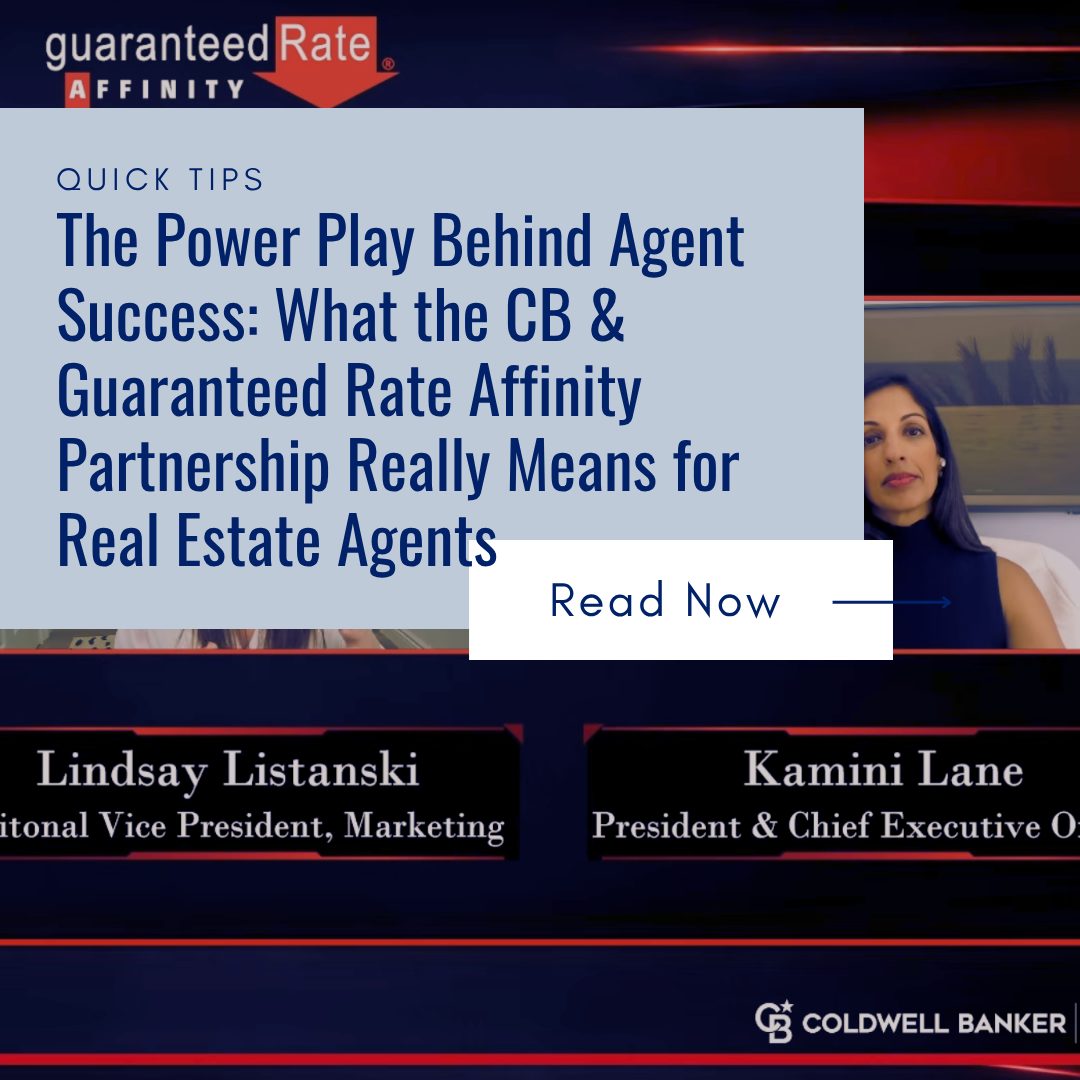
If you want a front-row seat to one of the most strategic conversations happening in real estate right now, the latest episode of the Better Together podcast delivers exactly that. Hosted by Lindsay Listanski, National Vice President of Marketing at Coldwell Banker, the episode brought together two of the most respected leaders in the industry — Kamini Lane, President and CEO of Coldwell Banker Realty, and David Dickey, President and Chief Production Officer of Guaranteed Rate Affinity — for a candid, deeply insightful conversation about the joint venture that is actively reshaping what it means to support a real estate agent in today’s market.
As a Field Marketing Specialist at Coldwell Banker, I watch how strategy translates to the field every single day. This conversation resonated with me on every level. The insights shared aren’t theoretical — they are immediately actionable, and every agent in our network should be paying close attention.
Here’s my full breakdown.
Why This Partnership Is More Relevant Today Than Ever Before
A Lot Has Changed Since 2017
The Coldwell Banker Realty and Guaranteed Rate Affinity partnership officially took shape in late 2017 and gained full momentum through 2018. Since then, the real estate landscape has shifted in ways none of us could have fully predicted. David Dickey put it plainly: affordability is still constrained, but accessibility, the range of products and programs available to buyers, has improved significantly over the last two to three years.
What struck me most, however, was the framing Kamini Lane offered. She made the point that more has changed in the interest rate and housing environment over the past nine years than in any comparable period in recent U.S. history. Between COVID, dramatic price acceleration, and interest rate swings in both directions, the consumer has been left disoriented. Her words were precise and powerful: it is really easy to not have enough information to make a smart decision about what is ultimately the most important financial and emotional decision of most people’s lives.
That’s not just context — that’s the entire case for why this partnership exists.
The Advisory Team Advantage
One of the strongest themes throughout the episode was the concept of the advisory team, the idea that today’s winning agent is not operating alone. They are backed by a bench of support that allows them to move faster, structure smarter deals, and deliver certainty to their clients.
What makes the CB and GR model unique is that this support is not remote or transactional. It is embedded. Loan officers are in the offices. They attend sales meetings. They walk open houses. They are present in a way that most brokerage-lender relationships simply are not. As Lindsay described it, agents benefit from a true trifecta of in-office support: their branch manager, their marketing team, and their loan officer, all accessible under the same roof.
No other platform in real estate offers this. That is not a marketing claim. That is a structural advantage.
What It Takes for Agents to Win More Business Right Now
Be Obsessed With Your Client
Kamini Lane’s answer to the question of what agents need to do to win more business was one of the most compelling moments of the entire episode. She said agents need to be obsessed with their clients, not just knowledgeable about the market, but deeply attuned to each individual client’s needs, preferences, and communication style.
She articulated it this way: agents need to understand what their clients are saying, what they are not saying, and what they want but haven’t yet verbalized. Some clients want a quick text. Others want a phone call every time. Some want content-rich emails. The best agents know the difference without being told twice.
She also made clear that market expertise, knowing your local inventory, pricing trends, and negotiating dynamics, is no longer a differentiator. It is table stakes. The cost of entry. What separates trusted advisors from average agents is the ability to combine that market expertise with a genuine, nuanced understanding of the human being they are serving.
Ask the Questions Others Won’t Ask
David Dickey shared a story that landed with me hard. One of their loan officers, Alonso, was working with a first-time homebuyer and asked so many thorough, probing questions during the consultation that the client temporarily went to a different lender, one who made the process seem simpler by asking fewer questions.
A few days before closing, that deal fell apart.
The client and their agent came back to Alonso. He had the loan approved with two conditions in 48 hours, and they closed. The lesson here is clear: thoroughness is not a burden to the client, it is protection. When agents and loan officers ask the hard questions upfront, they create deals that actually close. That is the kind of reliability that builds a career.
The Rate Lock-In Problem — And the Script to Address It
Unlocking the Frozen Seller
One of the most practical segments of the episode tackled what is arguably the biggest inventory challenge in the country right now: homeowners who are sitting on 2 and 3% COVID-era interest rates and have convinced themselves they can never move.
Lindsay posed a sharp, on-the-spot roleplay: If you could bring Dave and Kamini into the room with a client who said “I’m not giving up my 3% mortgage,” what’s the talk track?
Kamini’s response was brilliant in its simplicity. She reframed the conversation entirely: You are focusing on one very narrow aspect of your financial life. She pointed out that almost every market in the U.S. has experienced high single-digit to low double-digit price growth over the last decade. Homeowners are sitting on a pile of equity, a pile of cash, that they are refusing to unlock because of one data point in their financial picture.
David built on that: don’t give up on the school district you want, don’t give up on the pool. Talk to your GR loan officer about products that can help you deploy the equity you’ve already built and maintain payments that are comparable to what you have now, or even lower. The rate is just one lever.
As a Field Marketing Specialist, I can tell you that this reframing is something agents should be rehearsing and incorporating into every listing conversation. It is not a hard sell. It is education. And education is exactly what separates the top producers from the rest.
Open Houses as a Partnership Strategy
The Opportunity Most Agents Are Missing
David Dickey made a candid observation that I think every agent needs to hear: he dropped by multiple open houses recently and found zero loan officer presence at either one. No financing options. No buy-down conversations. No mortgage consultation. Just an agent holding down the space alone.
This is a missed opportunity of significant proportion.
Here’s what a GR loan officer can bring to an open house that changes the conversation for a seller and a buyer: the knowledge and ability to walk any interested visitor through a seller-paid buy-down scenario that makes the home more competitive than a price reduction would, and at less cost to the seller.
Why Buy-Downs Are a Listing Agent’s Competitive Edge
David walked through the math clearly. If a seller chooses to reduce their home price by 5%, the buyer absorbs a marginal benefit. But if that same seller uses just 2% of the sale price toward a buyer buy-down, the buyer’s monthly payment is cut in half for that period. Allocate the full 5% toward a buy-down instead of a price reduction, and the monthly payment savings nearly triple.
On an average sale, a 2% buy-down saves the buyer approximately $150 per month. A 5% buy-down saves them close to $400 per month. And critically, the seller nets more money than they would from a straight price reduction.
Most agents are not having this conversation. The ones who are, with a GR loan officer by their side, are winning listings that others are losing.
The Buyer Agency Integration: A Game-Changer for Emerging Agents
A Seamless Path From Agreement to Pre-Approval
One of the most exciting structural changes discussed in the episode was the integration of a GR mortgage consultation directly into the buyer representation agreement process. When an agent presents the buyer agreement, the client now has the option to receive a mortgage quote from Guaranteed Rate Affinity right within that workflow, removing friction and making the financing step feel like a natural part of the journey rather than an intimidating separate event.
The data behind this program is striking. David shared that nearly 47% of the agents involved in closed transactions through this program had never previously worked with GR. And 75% of those agents were emerging producers, agents closing three, four, or five buyer-side transactions per year.
Why This Matters for the Long Game
This is where the strategic depth of this partnership becomes especially clear. The top-producing agents who have had a strong mortgage relationship for ten, fifteen, or twenty years almost universally point to the same origin story: that loan officer was there for them when they were emerging.
The CB and GR integration is building those relationships at scale, at exactly the right moment in an agent’s career. That is not just good for today’s transaction — it is how you build a career defined by consistent closings and confident clients.
Why the Coldwell Banker Value Proposition Is Unmatched Right Now
120 Years of Integrity, a World-Class Technology Stack, and a Culture That You Feel
Kamini Lane’s answer to the recruiting value proposition question was both personal and precise. She noted that having led organizations across several major real estate brands, she can say with conviction that Coldwell Banker Realty’s value proposition is, in her words, literally unbeatable.
The reasons she cited:
- 120-year heritage built on integrity, ethics, and a duty to clients — a brand that has never wavered from doing the right thing
- Culture that is palpably felt — walk into any office, attend any sales meeting, sit in on any top-agent recognition event, and you will feel the difference
- Service obsession that runs from leadership through every support function — Kamini described CB as functioning like a hospitality company, where every team member is a customer service professional
- Technology partnership through Compass International Holdings, providing agents access to a platform that has benefited from over $2 billion in investment over more than a decade — specifically designed for real estate professionals
- Mortgage ecosystem that includes GR in-office, a digital option, and the recently announced Redfin and Rocket partnership — providing agents with the most comprehensive financing support in the industry
David Dickey echoed this, noting that the culture at Coldwell Banker is not performative. He has attended sales meetings across markets, virtually and in person, and the energy is real. Their loan officers spend significant time in CB offices and consistently feel like part of the team.
My Key Takeaways as a Real Estate Marketing Specialist
Watching this conversation through the lens of real estate marketing, a few principles stand out that I believe every agent should internalize and operationalize immediately:
1. Education is your most powerful marketing tool. Whether it’s buy-down math, equity reframing, or mortgage product options, the agents who educate are the agents who are trusted. And trusted agents get referrals, listings, and repeat business.
2. Your GR loan officer is a marketing asset — use them. Bring them to open houses. Include them in listing presentations. Let them co-present the financing story while you lead the real estate strategy. That tandem is genuinely rare in this industry and it is your competitive advantage.
3. Be obsessed with the client in front of you. Not the transaction. Not the commission. The person. Understand their timeline, their fears, their goals, and what they haven’t been able to articulate yet. That level of attention is what converts a one-time client into a lifelong relationship.
4. Emerging agents: build your mortgage relationship now. The loan officers who will be at your side for the next twenty years are the ones you meet and build trust with today. That relationship compounds.
5. The rate lock-in objection is a marketing problem, not a market problem. The sellers who are frozen are frozen because they have not been given the right information. Give them the information. Show them the equity. Show them the math. That is marketing — and it is your job.
Watch the Full Episode
If you have not yet watched this episode of the Better Together podcast, I strongly encourage you to do so. The conversation between Lindsay Listanski, Kamini Lane, and David Dickey is exactly the kind of strategic and practical dialogue that should be informing how every Coldwell Banker agent approaches their business in 2026.
This is the partnership. This is the advantage. Use it.
How Top Real Estate Agents Handle Seller Objections: Insights from Coldwell Banker’s Growth Mastermind – April 2026

What Real Estate Agents Need to Know About Handling Seller Objections
If you’re a real estate agent struggling to convert listing appointments into signed agreements, you’re not alone. One of the most common challenges agents face isn’t finding sellers—it’s convincing them to sign with you instead of your competitors, and at the commission rate you’re asking for.
That’s exactly why Coldwell Banker hosted its April 2026 Growth Mastermind event, bringing together some of the country’s top listing agents to share their real-world strategies for handling the tough conversations that happen during listing appointments.
This isn’t about manipulation. It’s about having the confidence, preparation, and framework to answer tough questions—from “Why should I pay you 4% when Premium One charges 1%?” to “I’m interviewing 17 other agents, so why should I choose you?”
In this comprehensive guide, I’m breaking down everything that was covered at this mastermind event, with a focus on how to handle seller objections like the pros do. Whether you’re new to the business or a seasoned agent, these strategies will help you earn more listings and build stronger relationships with your clients.
Understanding the Mindset: You Don’t Handle Objections—You Build Authority
Before we dive into tactical responses, we need to address something critical that Will Alfaro, one of the top listing agents in the country, emphasized at the Growth Mastermind: “I do not handle objections.”
This statement seems counterintuitive at first, but it reveals a fundamental truth about real estate marketing and listing success.
What “Not Handling Objections” Really Means
Will’s point wasn’t that objections don’t exist—they absolutely do. Rather, he was saying that when you build a strong reputation and authority score, most objections never materialize in the first place.
Think about it this way: If you called a celebrity agent to list your home, would you question their commission? Probably not. You’d assume they know what they’re doing and trust their expertise.
The lesson for real estate agents: Stop preparing for battles. Instead, focus on building your personal brand and authority in your market so that sellers want to work with you and trust your expertise from the moment you walk through the door.
This means:
- Being on time (or early) to every appointment
- Dressing professionally and presenting yourself as a polished expert
- Knowing your market data inside and out
- Having a consistent track record of results
- Actively building your reputation on social media and through referrals
The Authority Score: Why Reputation Matters More Than Tactics
During the role-play segment between Will and Ellen Gonick (the #9 solo agent in the country), Ellen played a difficult seller asking tough questions about commission, pricing, and competing agents.
What became clear wasn’t that Will had perfect scripted responses—it was that his authority score allowed him to lead the conversation confidently. He asked the questions. He controlled the narrative. And when challenges came up, he didn’t get defensive; he got strategic.
Your authority score is built on:
- Market expertise – Can you speak credibly about comparable sales?
- Professional presentation – Do you look like someone who knows what they’re doing?
- Track record – Can you show results in the seller’s neighborhood?
- Confidence in pricing – Do you have data to back up your recommendation?
- Relationship skills – Do sellers feel heard and understood?
The Three-Number Pricing Strategy: How to Stop Pricing Arguments Before They Start
One of the most common objections sellers raise is about price. “I think my house is worth $X,” or “My neighbor sold their house for more than you’re suggesting.”
Will introduced a powerful framework for addressing this objection: the three-number approach.
Number One – The Opinion of Appraisal Value
The first number you present is what you believe the home will appraise for. This is based on:
- Comparable sales (CMA – comparable market analysis)
- Price per square foot adjustments
- Condition factors and desirability characteristics
- Recent sales data from the neighborhood
Why this matters: The appraisal value is your insurance policy. If the buyer’s appraisal comes in lower than expected, you need to know how much of a gap you’ll need to cover. This protects the seller’s interests and keeps deals from falling apart.
When a seller says “My house is worth $X,” you can reference this appraisal opinion and explain the difference between what they think it’s worth and what a bank will say it’s worth—which are often two different numbers.
Number Two – The Strategic List Price
This is where psychology meets marketing. The list price isn’t necessarily what you think the house will sell for. Instead, it’s strategically set to drive the right traffic.
If you believe a house will appraise for $680,000, you might list it at $650,000 to attract buyers searching in that price range AND attract buyers searching up to $700,000. This expands your pool of potential buyers without underpricing the property.
The key distinction: Sellers often confuse list price with final sale price. They need to understand that the list price is about marketing strategy, not your opinion of value.
Number Three – The Target Sale Price
The third number is your projection—where you believe the home will actually sell, based on your experience, market conditions, and if you execute your marketing strategy correctly.
For example:
- Appraisal opinion: $680,000
- List price: $650,000 (strategic positioning)
- Target/projected sale price: $690,000 (with multiple offers in a strong market)
By presenting all three numbers with clear explanations of their purpose, you eliminate the confusion that leads to objections. Sellers understand you’re not just guessing—you’re using data and strategy.
Handling Commission Objections: The Strategic Response Framework
If there’s one objection every real estate agent dreads, it’s “Why should I pay you 4% when another agent charges 2%?”
This is where having the right framework makes all the difference.
The Reframe: You’re Not Negotiating Your Commission
The first critical insight from the Growth Mastermind: When a listing agent comes back and says they’ll only pay 2% instead of the 2.5% you asked for in your buyer’s commission, they’re not negotiating your commission. They’re negotiating how much their seller will pay.
This distinction changes everything.
Your buyer’s commission agreement is between you and your client—it’s fixed. The listing agent’s counter-offer about how much they’ll contribute doesn’t change what your buyer client owes you. It only changes who’s paying it.
The tactical response:
- Pull out your calculator
- Convert the percentage difference into actual dollars
- Reframe it as a price difference, not a commission discussion
For example: “So what you’re telling me is that the seller wants $7,000 more from my buyer. We can certainly discuss that as part of the offer price.”
Why You Shouldn’t Lead With Commission Questions
Many agents make the mistake of calling the listing agent before submitting an offer and asking, “How much are you offering out for buyer’s commission?”
Stop doing this.
Why? Because:
- You’re giving them permission to negotiate
- You’re starting the conversation in the wrong frame
- You’re signaling that commission is on the table
Instead, submit your offer with the commission your buyer agreed to pay. Let the listing agent come back if they have an issue with it. By then, the seller will have already accepted your offer’s price, and they won’t want to restart negotiations.
The “MLS Fee” Trap and How to Handle It
During the Growth Mastermind, there was significant discussion about agents trying to collect additional “MLS fees” ($125–$350) that weren’t agreed to upfront.
Here’s what you need to know: An MLS fee is a commission. It’s not a separate fee. And if it wasn’t in the original listing agreement, the buyer agent has no obligation to pay it.
If a listing agent tries to add an MLS fee at attorney review or closing:
- Don’t argue upfront
- Let your broker handle it if it becomes an issue
- Reference that the seller already accepted the offer without this fee
- Don’t let it kill the deal
The harsh reality? Most agents back down from MLS fee disputes because they realize they have no leverage. The buyer agreed to the offer as written.
The Buyer’s Agency Conversation: Preparing for the New Rules
Ryan Merwin, from Coldwell Banker’s Morristown office, shared critical insights about the post-August 2024 buyer’s agency landscape. This is essential for real estate agents to understand because buyer agreements directly impact your ability to close seller deals.
The DocuSign Template Strategy Every Agent Should Have
One of Ryan’s most practical recommendations: Set up DocuSign templates for single-property buyer’s agency agreements and CIS (co-broker information sheets) before you show any property.
Why? Because when a buyer calls wanting to see a listing at 2 PM on Saturday, you don’t want to scramble to get paperwork signed. You want to:
- Take their email address
- Send the DocuSign template from your phone (takes 30 seconds)
- Have them sign before you even leave your current location
This solves multiple problems:
- You’re complying with the law
- You’re demonstrating professionalism
- You’re filtering out buyers who aren’t serious
- You’re protecting yourself and your clients
Single-Property vs. Longer-Term Buyer Agreements
During the role-play, Ryan discussed the strategy of offering single-property buyer’s agency agreements for one-off showings, especially early in a relationship.
This is genius for several reasons:
- Buyers who are hesitant about commitment can agree to show one property
- Once they see results, they’re more comfortable signing longer-term agreements
- It builds trust gradually
- It filters out tire-kickers
As the relationship progresses and the buyer demonstrates commitment, you can upgrade to a longer-term agreement (3–6 months).
How to Explain Buyer Commission to Your Seller
When taking a listing, many sellers ask about buyer commission and what it costs them. Here’s the framework from the Growth Mastermind:
First, be clear about what you’re offering:
- “If we offer to cooperate with buyer’s agents, we’ll welcome offers from represented buyers. We’ll ask them to include their commission in the offer, and we’ll review all offers based on net proceeds to you.”
Second, explain the math:
- “Your buyer may have an agent who charges 2% or 2.5% or 3%. That’s between them and their agent. We’re not paying a set amount; we’re looking at the highest net offer.”
Third, address the objection directly:
- If a seller says, “But if I’m cooperating with buyer’s agents, won’t that cost me more?”
- You respond: “Actually, it typically means we get more offers, which drives your price up. That competitive situation usually more than offsets any buyer’s commission.”
The Unrepresented Buyer Issue: What the Data Actually Shows
One question that came up repeatedly at the Growth Mastermind: “How do you handle unrepresented buyers?”
The answer surprised many agents in the room.
What the Research Reveals
When Michael Pennisi asked the room of top agents, “Has anyone ever successfully closed a deal with an unrepresented buyer?” — not a single person raised their hand.
Not one.
In a room full of hundreds of top agents in New Jersey, there was a universal consensus: unrepresented buyers rarely close. When they do, they typically come in last in a multiple-offer situation and often don’t close at all.
Why Unrepresented Buyers Are a Red Flag
There’s typically only one reason a buyer wants to be unrepresented: to get the house for less money. They think if they don’t hire an agent, the seller will charge them less.
From a seller’s perspective, this is a risk factor. Unrepresented buyers often:
- Don’t know how to write proper offers
- Don’t understand contingencies and timelines
- Create friction and delays
- Have higher rates of deal failure
Your strategy as a listing agent:
- Set an unrepresented buyer fee (typically 1–1.5%) as a deterrent
- Explain it to your seller as protection, not as a revenue source
- Present it as a financial reality, not a preference
- When unrepresented buyers object, explain: “You can represent yourself, or you can hire a buyer’s agent. Most sellers prefer to work with represented buyers because it’s smoother.”
Building Confidence Through Discovery: The Real Secret to Handling Objections
Here’s something that doesn’t get talked about enough: Most objections dissolve when you do proper discovery.
What Discovery Really Means
Discovery isn’t interrogation. It’s having a genuine conversation with the seller to understand:
- Why are they selling NOW?
- What’s their timeline?
- What matters most to them—speed, price, or peace of mind?
- Have they had bad experiences with agents before?
- Are they working with other agents?
- What’s their emotional state about this sale?
When you understand these factors, objections stop being surprises. Instead, you’ve already addressed them through the conversation itself.
The Pre-Appointment Qualification
Here’s a framework that came up: Before you even agree to a listing appointment, you should be doing discovery.
Example: “I’m thrilled you want to talk about listing your home. Before we meet, I have a few quick questions so I can prepare the best strategy for your situation. How long have you been thinking about selling? Have you worked with an agent before? How many agents are you planning to interview?”
This accomplishes several things:
- You learn if they’re a serious seller or just shopping around
- You get context before the appointment
- You eliminate surprises (like finding out they’re interviewing 17 agents)
- You can decide if this is worth your time
Will was clear about this: If a seller tells you they’re interviewing 17 agents and won’t pay more than 1%, and you believe your value is worth 4%, don’t go to the appointment. You’re not the right fit for that client, and you’re wasting your time.
The Three-Visit Strategy vs. The One-Visit Close
Ellen Gonick shared that she doesn’t always do follow-up listing presentations. Instead, she closes the deal in one visit.
This is where your authority score becomes critical.
One Visit Listing Presentations
If you have a strong reputation and authority in your market, sellers are ready to sign based on your initial presentation because:
- They already know who you are
- They trust your expertise
- They’ve made their decision before you arrive
- You don’t need to “prove yourself”
How to know if you can pull this off: Do sellers in your market already know your name? Do they hire you because of your reputation, or do they hire you by default because you showed up?
Multi-Visit Presentations
If you’re building your authority or working in a new area, the traditional approach of discovery on visit one and presentation on visit two still works. It just requires:
- A clear agenda for each meeting
- Distinct value at each touchpoint
- Building momentum toward the close
The key is being intentional about what happens at each meeting—not just going through the motions.
Handling Price Pushback: When Sellers Think Their House Is Worth More
This is one of the most common objections agents face, and it requires a specific framework.
The “Neighbor Sold for More” Argument
Scenario: “My neighbor sold their house last year for $1.2M, and mine is the same size, so mine should be worth $1.2M too.”
The reality check: That neighbor probably:
- Listed at $900,000 to drive traffic
- Got multiple offers
- Had specific buyer psychology in their favor
- Had market conditions in their favor at that time
Your response: “You’re right that comparable sales matter. Here’s what I found: Your neighbor listed at $900,000 and sold for $1.2M. That happened in a specific market moment with specific buyer interest. To recreate that, we’d need to list at a strategic price to drive the same traffic and buyer frenzy. If we list at $1.2M, we won’t get that traffic, and we’ll sit on the market.”
Then show the data: “This is what we need to do to have a realistic shot at that price.”
The Overpriced Listing Trap
Will addressed an important concern: As an agent, you never want to overprice a listing because it damages your reputation in the marketplace.
When every other agent sees your listing at $1.2M when comparable data suggests $950,000, they question your credibility. Worse, when the house sits on the market for months, it becomes “stale,” and buyers wonder what’s wrong with it.
Your protection: Have clear conversations with sellers about price expectations upfront. If they insist on overpricing, you have options:
- Don’t take the listing
- Build in a price adjustment clause (automatically reduces price after 21 days if no offer)
- Increase your commission to account for the extra work (4% becomes 5%, for example)
- Get written agreement that the seller understands the risks
Creating Urgency Without Being Pushy
Ellen and Will both discussed strategies for creating legitimate urgency around offers and listing deadlines.
The Offer Deadline Strategy
Legal fact: Sellers can set offer deadlines. There’s nothing illegal about saying, “I’m accepting offers through Wednesday at noon.”
This creates urgency through scarcity, which often results in multiple offers and higher prices.
The framework:
- List the property strategically
- Hold showings for a narrow window (not open houses for 30 days)
- Set a clear offer deadline (e.g., Wednesday at noon)
- Communicate urgency without lying (“We have significant buyer interest, and we’re moving quickly”)
The difference between this and manipulation is honesty. Don’t tell an agent you have multiple offers if you don’t. Don’t misrepresent the situation. But DO communicate real market dynamics clearly.
The Language of Urgency
Instead of “We have 12 offers,” try:
- “Multiple agents have called about this property”
- “We’re receiving significant buyer interest”
- “We’re asking for highest and best offers”
- “The deadline is Wednesday at noon so we can review all offers together”
This is truthful, but it creates appropriate urgency.
Commission Floors and Standards: Why You Shouldn’t Discount Everything
Will introduced a concept that many agents overlook: the minimum commission floor.
Setting Your Standard
Will shared that his minimum listing commission is $20,000, regardless of the sale price. Here’s what this means:
- If the house is $500,000+, he charges 4% (which equals $20,000 or more)
- If the house is $400,000, he charges 5% (to hit his $20,000 minimum)
- If the house is $300,000, he may not take the listing
Why this matters: When you price your services too low, you’re saying your time and expertise aren’t valuable. You’re also setting an expectation that future clients won’t be able to meet.
The Authority Equation
The higher your authority and track record, the easier it is to maintain higher commission rates. Sellers pay for results and peace of mind, not just for putting the sign in the yard.
Your positioning:
- “My fee is 4% because I bring full-service marketing, team support, and a track record of selling homes for premium prices. That fee is earned through results.”
- Not: “My fee is 4%, but I might be flexible.”
The Role of Relationships: Why Connecting With Other Agents Matters
One theme that ran through the entire Growth Mastermind was the importance of building relationships with other agents, even (especially) your competitors.
The Information Advantage
When you have good relationships with other agents, they give you inside information that you can’t get any other way:
- “My buyer is committed to this property, but they can’t go higher”
- “My buyer is a tire-kicker; don’t waste your time”
- “My buyer would accept a counter offer”
- “My buyer was just fired by their previous agent”
This intelligence helps you make better decisions about whether to counter, how much to counter, and when to walk away.
The Collaboration Strategy
Rather than viewing every agent as a competitor, Will recommended inviting strong agents to collaborate.
Example: “I’m going into a neighborhood where there’s a dominant agent. Instead of competing against them, I invite them: ‘I have a seller interested in this area. Want to co-list with me for a 25% referral fee if we get it?'”
Now you’re combining forces instead of fighting each other. Both agents win. The seller wins because they get better service.
Real Estate Marketing Expertise: Positioning Yourself for Long-Term Success
As a real estate marketer (or agent building your personal brand), everything discussed at this Growth Mastermind boils down to one thing: positioning and authority.
Your Authority Score Is Your Best Asset
Every strategic element we’ve discussed—from pricing to commission conversations to handling objections—is easier when you have authority.
Your authority score comes from:
- Consistent social media presence showing market expertise
- Track record of results visible in your neighborhood
- Professional presentation and punctuality
- Deep market knowledge reflected in your conversations
- Genuine relationships with past clients and referral sources
- Thought leadership through content, interviews, or community involvement
Content as Authority Building
For agents reading this who want to build personal authority (or teams looking to position agents), creating and sharing educational content is critical.
That’s why this Growth Mastermind recap exists. By sharing what top agents are teaching, you’re positioning yourself as someone who:
- Stays current with market changes
- Learns from the best in the industry
- Translates complex information for your audience
- Cares about helping agents improve
This is the real estate marketing strategy that works long-term.
The Bottom Line: How to Handle Seller Objections Like the Pros
If you take away nothing else from this Growth Mastermind recap, remember these five principles:
1. Build Authority Before the Appointment
Focus on your reputation, market knowledge, and professional presentation. Strong authority eliminates most objections before they even arise.
2. Use Data to Answer Price Questions
Don’t argue about what a house is worth. Instead, present the three-number framework (appraisal value, strategic list price, target sale price) and let the data speak for itself.
3. Reframe Commission as Price
When listing agents push back on buyer’s commission, convert percentages to dollars and reframe it as a price negotiation, not a commission negotiation.
4. Do Thorough Discovery
Understand the seller’s motivations, timeline, and concerns before the appointment. Most objections dissolve when you’ve done proper discovery.
5. Know When to Walk Away
Not every seller is the right fit. It’s better to pass on a listing than to take one that will damage your reputation or waste your time.
Level Up Your Real Estate Game
The agents who shared their strategies at Coldwell Banker’s 2026 Growth Mastermind aren’t the best in the country because they’re naturally gifted at sales. They’re the best because they’ve developed systems, frameworks, and authority that make selling houses feel less like a battle and more like a natural extension of their expertise.
Whether you’re handling your first listing appointment or your hundredth, these principles apply. The tactics change based on your market and authority level, but the fundamentals remain the same:
Know your data. Build your authority. Understand your client. Lead with confidence. And never sell yourself short.
If you want to learn more from top-performing agents and stay current with real estate industry shifts, watch past Growth Mastermind sessions on Michael Pennisi’s YouTube channel. These events happen regularly and feature some of the most successful agents in the country sharing their exact strategies.
The best investment you can make in your real estate career is continuous learning from people who are already where you want to be.
Tell Stories, Not Listings: The LinkedIn Strategy That Actually Gets Real Estate Agents Found
The One Thing Every Real Estate Agent Gets Wrong
Here’s what happens on most real estate agents’ LinkedIn profiles:
“Just closed another amazing home in Wayne! Thank you to my incredible team…”
“New listing available! Check it out…”
“Market update: Home prices are trending up…”
Generic. Forgettable. Every single agent posts this exact thing.
Here’s what actually happens when you post this:
Nothing.
I recently met with an agent who was posting consistently on LinkedIn. Regular updates. Timely content. Professional headshots.
But when I looked at the engagement, every post had between 0 and 2 likes. Maybe a comment from a friend if they were lucky.
Then I looked deeper. I saw one post that was different. It wasn’t about a listing or market data. It was about an interaction with a client from 14 years ago. The post said:
“Just sold a home to someone I helped buy their first house 14 years ago in Wayne, NJ. Watching them build a life, raise kids, invest in their community… and now coming back to me to sell? That’s why I do this. 💙”
That post had 23 likes, 5 comments, and multiple people asking to talk with them about their real estate needs.
The difference? Story.
This guide is about understanding why stories work and exactly how to use them.
Why Stories Beat Facts and Listings
Let me explain the psychology and the technology.
The Human Brain is Wired for Stories
This is neuroscience, not marketing theory. When you present facts or data, your brain activates language processing areas. It’s analytical.
When you hear a story, your entire brain activates:
- Language processing
- Sensory cortex
- Motor cortex
- Emotional center
A story engages your whole brain. Facts engage your language center.
That’s why someone might forget a list of statistics about home prices, but they’ll remember a story about watching a family move into their dream home.
Stories Create Emotional Connection
Facts don’t create connection. “Home prices are up 5% in Wayne” is data.
Stories create connection. “I watched a young couple close on their first home yesterday, and they cried when they got the keys. That’s the moment that reminds me why I do this work” is connection.
When people feel emotionally connected to you, they want to work with you. They recommend you. They trust you.
Stories Make You Memorable
There are thousands of real estate agents. Most of them are interchangeable. They all look the same, say the same things, post the same content.
When you tell authentic stories, you become memorable. You become specific. You become real.
That’s the foundation of standing out.
AI Systems Reward Authentic Stories
Here’s a technical point: Modern AI systems (like those used by LinkedIn, Google, and search engines) are trained to recognize authentic, original content.
When you post a generic “Thank you for the closing!” post for the 47th time, AI recognizes it as repetitive. It doesn’t prioritize it.
When you post an authentic, unique story, AI recognizes it as original content. It prioritizes it for distribution.
Translation: Stories get more reach.
The Types of Stories That Work for Real Estate Agents
Let me show you the exact types of stories that generate engagement and leads.
Story Type #1 – The Client Journey Story
This is my personal favorite because it’s powerful and easy to tell.
What it looks like: You share the story of working with a client. The challenge they faced, the solution you provided, the outcome, and what it meant.
Example: “I met Sarah and Tom 3 years ago when they were scared first-time homebuyers. They’d been rejected for two mortgages. Their credit wasn’t great. The market was competitive.
I told them: ‘We can do this. Let me help you fix your financial picture. Let me show you what’s actually available to you.’
We got them pre-approved. We made strategic offers. We got them into a home in the Wayne school district.
Yesterday, I got a photo: their kid’s first day at the Wayne school. Sarah texted: ‘This was the dream. Thank you.’
THAT’S why I do this. Not because I sold a house. Because I helped create a life moment.
Are you a first-time buyer who’s been told no? Let’s talk. I’ve helped dozens of buyers who were told they couldn’t buy. You might be closer than you think.”
Why this works:
- Specific and detailed (not generic)
- Shows your value (you solved a problem)
- Builds trust (shows you care)
- Includes a call to action (targets your ideal client)
- Authentic emotion (not forced)
- Ends with a conversation-starter
Story Type #2 – The Market Insight Through Experience Story
Instead of saying “The market is shifting,” you tell a story about why you know the market is shifting.
Example: “I’ve been working in Wayne, NJ for 15 years. I remember when homes sat on the market for 60 days. I remember when interest rates were 3%.
Right now, I’m seeing something different. Homes are selling in 10-14 days. Interest rates are 6.5%. And I’m seeing something I’ve only seen twice in my career: multiple offers on properties that aren’t perfect.
Here’s what this means:
If you’re selling: Your timing is good. But don’t overprice. The market will correct fast if you do.
If you’re buying: You need to be ready. Pre-approval done. Inspection planned. When you find the home, you move in 24 hours.
This market favors the prepared.
What’s YOUR situation? Are you buying or selling right now? Let’s talk about what this market means for YOU.”
Why this works:
- Based on lived experience (not just regurgitated data)
- Provides context and credibility
- Offers practical, actionable advice
- Speaks to different audiences (buyers and sellers)
- Shows you’re paying attention
- Invites conversation
Story Type #3 – The Lesson Learned Story
You tell about a mistake you made or something you learned that might help others.
Example: “Early in my career, I made a bad offer on behalf of a buyer. It was too low. The seller rejected it immediately. The buyer missed out on the home.
I learned that offer strategy isn’t just about price. It’s about terms, timing, emotional appeal, and understanding what matters to the seller.
That lesson came back to haunt me for years until I really internalized it.
Now, when I help buyers, I don’t just talk about price. I help them tell their story to the seller. ‘This young family loves your home’ or ‘This retired couple wants to be near their grandkids.’ We make offers that sellers want to accept.
Has anyone rejected your offer on a home and you didn’t understand why? Sometimes it’s not about the money. Let’s talk about offer strategy that actually works.”
Why this works:
- Shows vulnerability (builds trust)
- Demonstrates growth and learning
- Provides actionable insight
- Invites people with similar challenges to engage
- Positions you as wise and experienced
Story Type #4 – The Community Impact Story
You share something you’ve noticed or done that impacts your community.
Example: “I’ve spent 15 years selling homes in Wayne, NJ. I’ve watched neighborhoods change. Downtown has revitalized. Schools have gotten better. New families have moved in.
Last week, I was at a community event and realized something: Almost every tenth person there was a client or former client. I’ve sold homes to maybe 200 families in this community.
That means I’ve helped create 200 lives happening in Wayne. 200 kids growing up here. 200 people investing in these neighborhoods.
I don’t take that responsibility lightly.
If you’re thinking about moving to Wayne, I’d love to help. Not just to sell you a house, but to welcome you to a community I care deeply about.”
Why this works:
- Shows community investment
- Demonstrates impact and scale
- Creates a sense of belonging
- Positions you as invested in the area, not just transactions
- Appeals to people who value community
Story Type #5 – The Personal/Human Story
You share something about your life that connects you to your market (and includes a real estate tie-in).
Example: “My dad has dementia. I spend a lot of time at his care facility, watching him forget things he’s known his whole life.
But he never forgets the first house we lived in as a family. Even with advanced dementia, he talks about that house. The backyard. The kitchen. The neighbors. The 4th of July celebrations.
Home isn’t about square footage. It’s about memories. It’s about the life you build there.
When I work with buyers, I don’t just show them houses. I help them imagine the life they’ll build there. The holidays. The kids running in the yard. The neighbors who become friends.
That’s what I’m really selling. A life. Not a house.”
Why this works:
- Shows your humanity
- Vulnerable and authentic
- Connects to deeper purpose
- Builds emotional resonance
- Differentiates you completely from other agents
- People will remember this
The Story Framework That Works
Not every story is created equal. Here’s the framework I recommend:
The Five-Part Story Structure
Part 1 – The Setup (1 sentence) Establish the context and introduce a challenge or situation.
Example: “I met with a seller yesterday who was terrified about the market.”
Part 2 – The Challenge (2-3 sentences) What was the problem? Why did it matter?
Example: “She’d been hearing about rising rates and falling prices. She thought she’d bought at the peak. She thought she’d lose money.”
Part 3 – The Action (2-3 sentences) What did you do? How did you help?
Example: “I pulled together 10 years of data. I showed her what homes in HER specific neighborhood had sold for. I showed her her home’s actual value based on recent comparables.”
Part 4 – The Outcome (1-2 sentences) What changed? What was the result?
Example: “She realized she wasn’t in a bad position. In fact, her home had appreciated slightly. She felt relieved and confident.”
Part 5 – The Invitation (1-2 sentences) What’s the lesson? Who should reach out?
Example: “If you’re scared about the market, let’s talk. Data beats fear. What’s YOUR situation? Let me know in the comments.”
Total length: 7-10 sentences. Short, punchy, readable.
The Story Authenticity Checklist
Before you post a story, check:
- Is this a real story about a real client or real situation? (Don’t make it up)
- Did this actually happen or am I dramatizing? (Tell the truth)
- Does it have emotion without being manipulative? (Feel something, but don’t fake tears)
- Does it include a specific detail that makes it real? (Not vague, actual details)
- Could my client recognize themselves if they read this? (Would they feel respected or violated?)
- Does it provide value beyond just me looking good? (What does the reader learn?)
- Is it vulnerable in a good way without oversharing? (Real but professional)
If you answer “no” to any of these, rewrite it.
Where to Tell Stories (And How to Optimize for Each Platform)
Stories work everywhere, but the format changes by platform.
LinkedIn Stories (150-400 words)
LinkedIn is perfect for detailed stories. People are there to read. They have time.
Format:
- Start with a hook: “I just had the most interesting conversation…”
- Tell the 5-part story
- End with a clear call to action
- Use line breaks to make it scannable
- Include relevant emoji (not overdone)
Example format: “I had the most interesting conversation with a seller yesterday.
[Story here]
What’s YOUR situation? Buying? Selling? Just curious about the market? Let’s talk. Comment below 👇”
Facebook Stories (200-300 words)
Facebook is more casual than LinkedIn. Tone can be warmer.
Format:
- More conversational opening
- Slightly longer story with more context
- Emphasis on community/relationship
- Clear CTA but warmer tone
Example: “Had the coolest moment today… [Story].
If you’re thinking about buying or selling, that’s what real estate should feel like. Let’s grab coffee and talk about YOUR goals ☕”
Instagram Stories (Shorter, Visual-First)
Instagram Stories (the temporary 24-hour stories, not the feed) are perfect for quick stories.
Format:
- 1-3 slides of text
- Casual, authentic tone
- Visual background
- Quick story or insight
- Swipe-up CTA (if you have it) or “DM me” CTA
Email Newsletter Stories
If you have an email list, use it for your best stories.
Format:
- Most detailed version of the story
- Can be 500+ words
- Include emotional depth
- Strong CTA to book a call or visit your website
Your Blog/Website Stories
Your website blog is perfect for long-form storytelling.
Format:
- 800-1500 words
- Include context and background
- Can be more personal
- Optimize for SEO (include location keywords, etc.)
- Include clear CTA
The Storytelling Content Calendar
Here’s a simple system to ensure you’re telling stories regularly:
Weekly Story Schedule
Monday: Client journey story (how you helped someone) Wednesday: Market insight story (what you’re seeing in the market) Friday: Personal/human story (something real about you or your family)
Every other week, substitute one post with:
- Lesson learned story
- Community impact story
- Behind-the-scenes story
Total: 3-4 stories per week across all platforms
This doesn’t require new stories every day. You’re building a library of stories you can adapt across platforms.
How to Find Stories When You Think You Don’t Have Any
Most agents say, “I don’t have any stories to tell. I just sell houses.”
That’s not true. You have plenty of stories. You just haven’t noticed them.
Story Mining Questions to Ask Yourself Daily
After a client interaction, ask:
- Did something unexpected happen?
- Did someone overcome a challenge?
- Did I learn something?
- Did something make me happy/sad/proud?
- Did someone do something kind?
- Did something surprising happen in the market?
- Did I see something change in my community?
Any “yes” is a potential story.
How to Capture Stories as They Happen
Keep your phone handy. When something story-worthy happens:
- Take a note immediately – “Had interesting conversation with first-time buyers about fears”
- Jot down details – Names, emotions, specific moments
- Capture the insight – “Lesson: People fear the unknown, not the actual process”
When you sit down to write that night or next day, the details are fresh.
Story Ideas From Your Daily Work
You already have dozens of stories:
- A client who was rejected by other agents but you helped
- A neighborhood you love and why
- A listing that surprised you (good or bad)
- A buyer who got emotional when they got keys
- A seller who was nervous and you helped them feel confident
- A challenging negotiation you navigated
- A time you had to give someone hard news
- A market shift you predicted
- A client from years ago who came back
- A neighborhood change you’ve watched happen
- A question you get asked repeatedly (and the story behind why it matters)
You’re not short on stories. You’re just not noticing them.
The One Rule for Storytelling: Authenticity
Everything in this guide comes down to one thing: Be real.
Don’t:
- ❌ Make up stories
- ❌ Exaggerate what happened
- ❌ Use fake emotion
- ❌ Dramatize for clicks
- ❌ Post stories that aren’t yours
Do:
- ✅ Tell what actually happened
- ✅ Include specific, real details
- ✅ Share genuine emotion
- ✅ Respect your clients’ privacy (change details if needed)
- ✅ Let your real personality show
People can tell the difference between authentic and fake. AI can too. Authentic wins every time.
What Happens When You Tell Stories Consistently
Real changes happen:
You Stop Blending In With Every Other Agent
Most agents post generic, forgettable content. When you tell stories, you stand out.
People Start to Know You
Authenticity builds familiarity. When people follow your stories, they start to feel like they know you. That’s trust. That’s business.
You Get More Inquiries
Engagement increases. Messages increase. Qualified leads start reaching out because they feel like they know and trust you.
Referrals Increase
People refer agents they know and trust. Stories build that knowledge and trust faster than any listing post ever will.
Ready to Start Telling Your Story?
Here’s what I recommend:
- Identify one story this week – Something real that happened
- Write it using the 5-part framework from this guide
- Post it on LinkedIn – That’s the best platform to start
- Notice the response – People will engage
Then do it again next week. And the week after. Stories compound. The more you tell, the stronger your brand becomes.
If you want professional guidance on developing your storytelling strategy, optimizing your LinkedIn presence, or building an authentic personal brand, that’s exactly what I help agents with.
As a Real Estate Marketing Specialist at Coldwell Banker, I work with agents to develop authentic, compelling stories that build real connections with clients. I’ll help you identify your best stories, craft them for maximum impact, and build a storytelling system that generates consistent leads.
The world doesn’t need more generic real estate agents. The world needs more authentic humans who happen to sell real estate.
Tell your story. The right clients are waiting to hear it.
From Zero Views to Engaged Buyers: The Real Estate Agent’s Guide to Video and YouTube Optimization
The Most Ignored Marketing Channel in Real Estate
I recently looked at a real estate agent’s YouTube channel. They had 47 videos posted over 8 years.
The most recent video? Posted over a year ago.
Engagement on most videos? Single-digit views.
But then I noticed something odd: They had one video that got 147 views, 12 comments, and 7 shares.
What made that video different?
It had them in it. Talking directly to the camera. With personality.
Here’s what I’ve learned through countless audits: The difference between a YouTube channel that works and one that doesn’t isn’t the equipment. It’s not the content. It’s consistency and personality.
YouTube is one of the most valuable marketing channels available to real estate agents. It’s the second largest search engine after Google. It drives qualified traffic. It builds authority. It costs nothing.
Yet 90% of agents either abandon their YouTube channels or post the wrong kind of content.
This guide is about fixing that.
Why YouTube Actually Matters for Your Real Estate Business
YouTube is a Search Engine (Second Largest in the World)
Most agents think of YouTube as “watching videos.” But YouTube is actually a search engine. When someone searches “what’s it like to live in Alpine, New Jersey” YouTube appears in the results.
If your video answers that question, you could appear in:
- YouTube search results
- Google regular search results
- Suggested videos
That’s three different ways to get found.
YouTube Videos Rank in Google
Here’s something most agents don’t realize: A well-optimized YouTube video can rank in Google’s regular search results (not just YouTube search).
If you have a video titled “5 Reasons to Buy a Home in Closter, New Jersey in 2026,” that video could appear when someone Googles that exact phrase.
Your written blog post competes with millions of other blog posts. Your YouTube video competes with fewer videos on the same topic. The competition is lower, but the impact is higher.
Video Gets Exponentially More Engagement Than Static Content
Remember the agent I mentioned? Their text listing post got 2 likes. Their video post got 23 likes and 3 comments.
Video engagement is typically:
- 3x higher than photos
- 5x higher than written posts
- 10x more likely to generate messages and inquiries
Why? Because when people see you on video, they connect with you as a human. They see your personality. They imagine working with you. It changes the equation entirely.
AI Systems Favor Video Content
Here’s a technical fact: AI systems are increasingly trained to recognize and prioritize video content. Search engines give video content a “boost” in recommendations because they know:
- Video keeps people on the platform longer
- People engage more with video
- Video demonstrates expertise better than text
When you post video, AI takes notice.
YouTube Builds Your Authority
A YouTube channel with 100 videos (even if each has only 20 views) signals something to potential clients: You’re serious. You’re consistent. You’re committed to this business.
An agent with no YouTube presence? It signals the opposite.
Why Your Current YouTube Strategy Isn’t Working
If you’ve posted on YouTube and gotten minimal results, here are the exact reasons why:
Reason #1 – Your Titles Are Unsearchable
❌ Bad title: “123 Main Street, Wyckoff, NJ”
This is a common mistake. Real estate agents put the address in the title, thinking that’s what people search for. Nobody searches for an address. They search for:
- “House for sale in Wyckoff, New Jersey”
- “Luxury homes in Wyckoff NJ”
- “Beautiful kitchen renovation”
- “Modern home in downtown Wyckoff”
When your title is just an address, nobody searches for it, and AI can’t categorize it.
✅ Good title: “Newly Renovated Home in Downtown Wyckoff – Perfect for First-Time Buyers – 123 Main Street”
This version has:
- A searchable description (newly renovated, first-time buyers)
- A specific location (down town Wyckoff)
- A benefit statement (perfect for…)
- The address (for those who want the specific details)
Now someone searching “newly renovated homes in Wyckoff” might find this video.
Reason #2 – Your Descriptions Are Empty
❌ Bad description: “Beautiful home. See listing here. [Link]”
That’s it. No context. No keywords. AI has nothing to work with.
✅ Good description: “This beautiful home at 123 Main Street in Wyckoff, New Jersey is the perfect fit for first-time homebuyers and young families. Here’s what makes it special:
✓ Newly renovated kitchen with granite counters ✓ 4 spacious bedrooms, perfect for growing families
✓ Walking distance to downtown Wyckoff shops and restaurants ✓ Great schools in the Wyckoff district ✓ Backyard perfect for kids and pets
Whether you’re buying your first home or trading up, let’s talk about what Wyckoff has to offer.
Learn more: [Link] Contact me: [Phone] | [Email]
#WyckoffNJ #RealEstate #HomesForSale”
This description:
- Explains what the video is about
- Uses location keywords naturally
- Lists specific benefits
- Targets a specific buyer type
- Includes contact information
- Uses relevant hashtags
Reason #3 – You’re Posting Listing Videos Without Context
❌ Bad approach: Auto-post a listing video showing rooms with background music. No you. No explanation.
People watch this and think: “This is a house. I already know this is a house. Why am I watching this?”
✅ Good approach: You walk through the property on camera, talking directly to viewers.
“Hey, welcome to 123 Main Street in Wyckoff. I’m [Your Name], and I want to show you something special about this home.
Walk in here—see how the light comes through these windows? That’s because this home faces south, so you get that afternoon light all year long.
Here’s what I love about this kitchen… [Show and explain]
If you’re thinking about buying in Wyckoff, this is what the market looks like right now. Properties like this are moving fast. Want to talk about whether this could be your home?”
Now the viewer is connected to YOU, not just the property.
Reason #4 – Inconsistent Posting Schedule
You post one video, wait 6 months, post another. YouTube (and AI) rewards consistency. Channels that post regularly get recommended more. Channels with sporadic posts get buried.
Reason #5 – No Playlist or Organization
You have listing videos, market update videos, home tour videos, all just sitting there in a jumbled list.
Viewers don’t know where to look. AI can’t organize your content effectively. Neither can potential buyers.
H2: The Complete YouTube Optimization Blueprint
Let me show you exactly how to fix this.
Step 1 – Optimize Your Channel Setup
Before you post a single video, set up your YouTube channel correctly.
Channel name: Should include your name and location
- ❌ “Real Estate Agent”
- ✅ “Joan Agent – Wyckoff, New Jersey Real Estate”
Channel description: “Welcome! I’m [Your Name], a real estate agent serving Wyckoff, New Jersey and surrounding communities. On this channel, I share:
✓ Virtual home tours ✓ Local market updates
✓ Tips for buying and selling ✓ Life in [Your Communities]
If you’re thinking about buying or selling, let’s talk. I work with first-time homebuyers, families, and sellers in [locations].
Contact: [Phone] | [Email] Website: [Your Website]”
Channel art and profile picture:
- Use your consistent professional headshot (same as all other platforms)
- Use consistent branding colors/logo if you have one
Links section:
- Website link
- Social media profiles
Step 2 – Create a Playlist System
Organization matters. Create playlists for:
Playlist #1 – Neighborhood Guides
- “Living in Wyckoff, New Jersey”
- “Is Alpine Right for You?”
- “Downtown Ridgewood Guide”
- etc.
Playlist #2 – Buying Tips
- “First-Time Homebuyer Guide”
- “What to Expect During Home Inspection”
- “How Much House Can You Afford?”
- etc.
Playlist #3 – Market Updates
- “Wyckoff Real Estate Market Update – March 2024”
- “Interest Rates Are Changing – What It Means for You”
- etc.
Playlist #4 – Listing Videos
- “Homes for Sale in Wyckoff”
- “Recent Sales in Ridgewood”
- etc.
Organize your existing videos into these playlists. New viewers can browse by interest. AI can categorize your content. Everyone wins.
Step 3 – Master the Title Formula
Use this formula for every video:
[Specific Description] – [Location] – [Benefit or Call to Action]
Examples that work:
✅ “Stunning Kitchen Renovation in Fort Lee, New Jersey – Home Tour” ✅ “5 Reasons First-Time Buyers Love Somers” ✅ “What the Spring Market Means for Sellers in 2026” ✅ “Dream Backyard for Kids – Downtown Jersey City Home” ✅ “New Construction in Rye, NY – Inside Tour”
Each title:
- States what the video is about (searchable terms)
- Includes location
- Hints at benefit or reason to watch
Step 4 – Write Detailed, Keyword-Rich Descriptions
Your description should be 200-300 words. Here’s the formula:
Paragraph 1 – What This Video Is About: “In this video, I’m giving you a complete tour of [Address] in [City], [State]. This [3BR, 2BA] home is perfect for [target buyer type] and here’s why…”
Paragraph 2 – Specific Details & Keywords: “What makes this home special:
✓ [Specific feature #1] – [Why it matters] ✓ [Specific feature #2] – [Why it matters]
✓ [Location benefit] – [Why it matters] ✓ [School/community benefit] – [Why it matters]
If you’re looking for a home in [City] with [specific features], this might be it.”
Paragraph 3 – Call to Action: “Thinking about buying in [City]? Let’s talk about what’s available in your price range and neighborhood. Contact me at [Phone] or [Email].
Interested in seeing this property in person? Click the link below to schedule a showing.”
Paragraph 4 – Links & Tags: “Learn more: [Listing link] Visit my website: [Website] Follow me: [Social media links]
#[CityName]RealEstate #HomesForSale #[CityName]Homes”
H3: Step 5 – The Video Content That Actually Works
Here are the types of videos that get real engagement:
Type #1 – You Talking Directly to Camera
This is the #1 engagement driver. You, on camera, talking about:
- Market conditions
- A specific neighborhood
- Tips for buyers
- Updates about listings
- Your perspective on real estate
Even just 60 seconds of you talking gets more engagement than a 10-minute property walkthrough with no commentary.
Example: “Real quick market update. I’m seeing something interesting in Burlington right now. Homes are taking about 14 days to sell on average, which is down from 21 days last month. If you’re a seller, that’s good news. Properties are moving. If you’re a buyer, the inventory is tighter, so if you see something you like, move faster. Let’s talk about what this means for YOUR situation.”
Type #2 – Property Walkthroughs With You
Not auto-play videos of properties. You walking through, talking, explaining:
- “Here’s why this kitchen is special…”
- “Look at how the light hits this corner…”
- “If you have kids, look at this backyard…”
- “This home checks these boxes for families…”
H3: Step 6 – Optimal Video Length
Sweet spots:
- Market updates: 60-90 seconds
- Neighborhood guides: 3-5 minutes
- Property tours: 3-7 minutes
- Longer tips/tutorials: 5-10 minutes
Don’t overthink length. If you have something valuable to say in 2 minutes, post 2 minutes. If you need 8 minutes, take 8 minutes. But generally, shorter is better on YouTube.
H3: Step 7 – Posting Consistency
Pick a schedule and stick to it. I recommend:
Minimum: 1 video per week Ideal: 2-3 videos per week Maximum: Daily (only if quality stays high)
Consistency matters more than frequency. One video per week, every week, beats three videos one week and nothing for two months.
Content Ideas That Get Real Results
Here are specific video ideas that real estate agents can post repeatedly with good results:
Recurring Content Ideas
Monthly Market Update (60-90 seconds)
- “Here’s what happened in the market in March in Wyckoff”
- Focus on: Days on market, price trends, inventory levels, what it means for buyers/sellers
Weekly Neighborhood Spotlight (3-5 minutes)
- Pick a different neighborhood each week
- Cover: What’s it like to live there, schools, walkability, community, demographics, price range
Bi-Weekly Buyer Tips (3-5 minutes)
- “What to expect during home inspection”
- “How to make an offer that gets accepted”
- “Questions to ask your realtor”
- “First-time buyer mistakes to avoid”
As-Needed Property Tours (3-7 minutes)
- Post when you have new listings
- Focus on features and benefits, not just showing rooms
You Talking (60-90 seconds)
- Share your perspective on market conditions
- Discuss local news affecting real estate
- Share tips or advice
Common Mistakes That Kill Your YouTube Channel
Mistake #1 – Depending on Auto-Posts
If you’re using a listing service or MLS auto-post tool that creates basic videos without you in them, stop. These videos:
- Don’t differentiate you
- Have zero personality
- Don’t engage viewers
- Get buried in search
Use them as supplementary content, not your main content.
Mistake #2 – Ignoring Comments
When someone comments on your video, respond. Within 24 hours. Even if the comment is just “nice place!” respond with something personal. This builds engagement and signals to YouTube that your channel is active.
Mistake #3 – Not Using Keywords in Descriptions
I see descriptions like “Nice home. See listing.” That’s wasted space. Your description should be 200+ words with natural keyword placement for:
- Specific location
- Property type
- Buyer type
- Features/benefits
- What makes it unique
Mistake #4 – Inconsistent Branding
Your YouTube channel should look and feel the same as:
- Your website
- Your social media
- Your business cards
- Your Google Business Profile
Consistent logo, colors, fonts, headshot. Make it cohesive.
Mistake #5 – Uploading But Not Promoting
Don’t just upload a video and wait for people to find it. Share it on:
- Your email newsletter
- Your social media (Facebook, Instagram, LinkedIn)
- Your website
- Your blog posts
Cross-promotion amplifies your reach.
The 90-Day YouTube Action Plan
Ready to actually build a YouTube channel that works? Here’s your step-by-step plan:
Month 1 – Setup and Foundation
Week 1:
- Optimize your channel (header, description, playlists)
- Update your profile picture with your consistent headshot
- Create your playlist structure
Week 2-4:
- Record and post one video per week
- Start with “you talking” videos (these are easiest and get the best engagement)
- Focus on quality over production value
Videos to post:
- Introduction – “Hi, I’m [Name], and here’s what you’ll find on this channel”
- Market update
- Neighborhood guide
- Buyer tip
Month 2 – Consistency and Growth
Post 4-8 videos this month
- Continue “you talking” content (easiest to produce, most engagement)
- Start adding property tours
- Begin responding to all comments
- Cross-promote on social media
Videos to post:
- Monthly market update
- Neighborhood spotlight
- Buyer tips (2-3 videos)
- Property tour
- Your perspective on a local real estate news item
Month 3 – Optimization and Momentum
Post 4-8 videos this month
By now you have 8-16 videos. You should be seeing:
- Increased views
- More engagement
- Maybe some subscriber growth
Continue the pattern:
- Weekly consistency
- Mix of market updates, tips, neighborhood guides, property tours
- Always include you on camera at least once per week
Measuring Success
Don’t expect massive views immediately. YouTube takes time to build. But here’s what you should see:
Month 1: 20-50 total views across all videos, maybe 1-2 comments
Month 2: 50-150 total views, engagement picking up
Month 3: 100-300 views, 3-5 comments, maybe 5-10 subscribers
Month 6: 500+ total views, regular engagement, 20-50 subscribers
Year 1: If consistent, you could have 1,000-5,000 total views, 50-200 subscribers, and regular lead generation from YouTube
These numbers might seem small. But remember: Even 10 views from qualified buyers in your market is better than 1,000 generic views.
Ready to Build a YouTube Channel That Works?
Here’s my recommendation:
- Set up your channel properly – Use the blueprint above
- Plan your first month of content – 4 videos minimum
- Commit to consistency – At least one video per week
- Track what works – Notice which videos get engagement
- Adjust based on feedback – Double down on what works
If you want professional guidance on video strategy, optimization, and YouTube growth, that’s exactly what I specialize in.
As a Real Estate Marketing Specialist at Coldwell Banker, I help agents build YouTube channels and video strategies that actually generate leads. I’ll review your current channel (if you have one), create an optimization plan, and help you develop a content strategy that works.
Book Your Video Strategy Consultation
YouTube is not optional anymore. It’s one of the most valuable platforms available to real estate agents. Start today. Post one video this week. Then do it again next week. The compounding effect is real.
The Power of Consistent Branding: Why Your Headshot and Bio Matter More Than You Think

The $10,000 Problem Most Agents Don’t Realize They Have
Here’s a scenario that happens more often than you’d think:
A potential buyer searches for you on Google. They find your Google Business Profile. You look professional, credible, accessible. They click through to your Instagram. Different photo. Different bio. Different tone.
Then they check your LinkedIn. Yet another photo. No professional photo, actually—or maybe your old photo from 2009.
Your website has a fourth version of your bio.
What do you think happens next?
The potential buyer thinks: “Is this the same person? Why don’t they look the same? Why do I feel like I’m looking at different people? Can I actually trust this?”
They move on to your competitor.
This happens constantly. And most agents don’t realize they’re doing it.
I recently met with a real estate agent who had a different professional photo on almost every platform. Their bio said different things in different places. Their tone and presentation were completely inconsistent. When I pointed it out, they said, “I didn’t even realize I was doing that.”
That inconsistency cost them credibility. It also cost them clients.
Here’s the hard truth: Consistency isn’t just nice to have. It’s essential for:
- Building trust with potential clients
- Being recognized by AI systems that use facial recognition and pattern matching
- Ranking higher in search results
- Appearing professional and intentional
This guide is about fixing that.
Why AI Systems Care About Consistency (And You Should Too)
Let me explain the technology side first, then the human side.
How AI Systems Use Facial Recognition
Modern AI systems (used by Google, Facebook, LinkedIn, and increasingly by search engines) have facial recognition capabilities. When you use the same photo across platforms, AI systems recognize that these profiles belong to the same person.
When your profiles are consistent:
- ✅ AI knows all these profiles are YOU
- ✅ AI can build a more complete picture of who you are
- ✅ AI can recommend you more effectively
- ✅ Search engines treat you as an established, legitimate professional
When your profiles are inconsistent:
- ❌ AI might think these are different people
- ❌ AI can’t build a cohesive profile
- ❌ Search engines don’t know how to categorize you
- ❌ You appear scattered and unprofessional
How Search Engines Use Consistency Signals
Google’s algorithm rewards businesses that appear consistent across the web. It’s part of something called E-E-A-T:
- Expertise – Do you demonstrate knowledge?
- Experience – Do you show you’ve been doing this?
- Authoritativeness – Are you recognized as an authority?
- Trustworthiness – Can people trust you?
Consistency builds all four of these. When your name, photo, bio, credentials, and information match across platforms, Google sees you as trustworthy and authoritative.
Inconsistency signals the opposite.
How People Psychologically Respond to Consistency
This is the human side, and it’s just as important as the technical side.
Our brains are pattern-recognition machines. We feel comfortable with consistency and suspicious of inconsistency. When you look professional on Google but unprofessional on Instagram, when your bio says different things in different places, people feel:
- Confused
- Uncertain
- Less trusting
- Less likely to reach out
Consistency signals: “This person has their act together. This person is professional. This person is worth working with.”
The Five Consistency Elements That Matter Most
Let me break down exactly what needs to be consistent across all platforms:
Element #1 – Your Professional Headshot
This is the #1 consistency issue I see. Agents have:
- A photo from 2009 on LinkedIn
- A different photo from 2015 on Google Business Profile
- A selfie on Instagram
- No photo on their website
- Yet another photo on Facebook
The fix: Get ONE professional headshot. Use it everywhere.
What to include in your headshot:
- Recent photo (within the last 2 years)
- Professional clothing
- Clear, well-lit face
- Genuine smile
- Neutral or professional background
- Consistent framing (not too close, not too far)
The headshot specs that work:
- Minimum 300×300 pixels (300 DPI for printing)
- Headshot only (not full body unless specifically needed for LinkedIn)
- Professional quality (not a smartphone selfie)
- Consistent across all platforms
Pro tip: Many agents say, “I need a new headshot, so I’ll wait to update my profiles.” Don’t do this. Get your headshot updated NOW, then immediately update all platforms. Don’t wait for the perfect moment—do it today.
If you’re concerned about cost, there are professional headshot services that cost $150-300. This is non-negotiable. It’s the foundation of your entire brand. And if you want to try it, there’s Ai headshots available on Design Concierge (Coldwell Banker Only).
Element #2 – Your Professional Bio
This is closely related to your Google Business Profile bio, but it applies across all platforms.
The consistency rule: Your core bio should be nearly identical everywhere. Small platform-specific tweaks are okay, but the core message should be the same.
Example of consistent bios across platforms:
Google Business Profile (full version): “Certified Real Estate Agent serving Alpine, New Jersey and surrounding communities including Closter, Ridgewood, and Wyckoff. I help first-time homebuyers, growing families, and sellers navigate the market with personalized, one-on-one service. As a Coldwell Banker Real Estate Specialist with 15+ years of experience, I bring deep local market knowledge and a commitment to transparent, client-focused representation. No team handoffs—you work directly with me.”
LinkedIn (professional focus): “Real Estate Agent at Coldwell Banker | Alpine, NJ & Surrounding Markets | First-Time Homebuyer Specialist | Real Estate Expert | 15+ Years of Local Market Expertise | No Team Handoffs—Direct Representation”
Instagram (conversational but consistent): “Helping families find home in Alpine, NJ, Ridgewood & Wyckoff 🏡 First-time buyer expert | Coldwell Banker Real Estate Specialist | Direct service, not team handoffs | Let’s talk about YOUR next home ☕”
Facebook (community-focused): “Welcome! I’m a real estate agent serving Alpine and surrounding New Jersey communities. I specialize in helping first-time homebuyers and families find homes they love. Work directly with me—no team handoffs, just personalized service. Let’s talk about your goals!”
Notice what stays consistent:
- ✅ Your name and credentials
- ✅ Your location(s)
- ✅ Who you help (first-time buyers, families)
- ✅ Your unique angle (no team handoffs, personal service)
- ✅ Your experience level
- ✅ Your company (Coldwell Banker)
What changes:
- Platform-appropriate length (LinkedIn is professional, Instagram is conversational)
- Platform-appropriate formatting (hashtags on Instagram, not on LinkedIn)
- Platform-appropriate tone (Facebook is warm, LinkedIn is professional)
The key: A potential client should be able to read your bio on any platform and come away with the same understanding of who you are and what you offer.
Element #3 – Your Company Information and Contact Details
This seems obvious, but it’s where inconsistency causes real problems.
What needs to be identical:
- Phone number (same number on ALL platforms)
- Email address (same email everywhere)
- Office address (exact same address, same formatting)
- Company name (Coldwell Banker, not “Coldwell Banker Realty,” not “Cold Well Banker,” etc.)
What should be consistent where applicable:
- Your website URL
- Your social media handles
Why this matters: Google uses this information to verify you’re a real person/business. When your phone number is different on your website vs. Google vs. Facebook, Google’s algorithm sees this as inconsistent information and downgrades your credibility.
Action item: Right now, audit yourself:
- Open Google, LinkedIn, Facebook, Instagram, your website
- Write down your phone number on each one
- Are they identical? If not, fix it immediately.
Element #4 – Your Brand Voice and Tone
This is more subtle, but it matters.
Inconsistent tone example:
- Google Bio: “Licensed Real Estate Agent with expertise in residential properties”
- Instagram: “OMG GUYS CHECK OUT THIS SICK LISTING 🔥🔥🔥”
- LinkedIn: “As a thought leader in real estate solutions…”
- Facebook: “hey just a friendly neighborhood realtor here to help”
These feel like different people. Your potential clients feel the whiplash.
Consistent tone example:
- Google: Professional, knowledgeable, service-focused
- Instagram: Warm, personal, professional (with appropriate emojis)
- LinkedIn: Professional, expert-focused, achievement-oriented
- Facebook: Warm, community-focused, approachable
The tone shifts slightly for each platform, but it’s clearly the SAME person behind all of them.
Element #5 – Your Unique Positioning
Across all platforms, what makes you different should be clear and consistent.
Examples of consistent positioning:
- “I specialize in first-time homebuyers”
- “I’m the agent who gets you direct representation, not a team”
- “I’m obsessed with the Alpine school district market”
- “I help investors build wealth through real estate”
Whatever your positioning is, it should show up consistently across platforms. It’s part of what makes you memorable and recognizable.
The Complete Consistency Audit Checklist
Here’s exactly what to check and fix:
Photos – Consistency Checklist
- Professional headshot used on Google Business Profile
- Same headshot used on LinkedIn
- Same headshot used on Instagram (or at minimum, a similar professional photo)
- Same headshot used on Facebook profile picture
- Same headshot used on website
- Same headshot used on any other platform where you have a presence
- All photos are recent (within last 2 years)
- All photos are professional quality
- Headshot is professional/business-appropriate across all platforms
Bio – Consistency Checklist
- Your name appears the same everywhere
- Your credentials/title are consistent (Real Estate Agent, Realtor)
- Your primary location is mentioned on every platform
- Your company name is spelled identically everywhere
- Your unique positioning/specialty is mentioned on every platform
- Your tone is professional and consistent (not swinging from stuffy to overly casual)
- Your contact information (phone/email) is identical
- You mention what makes you different (e.g., “direct service,” “no team handoffs,” “local expert”)
Contact Information – Consistency Checklist
- Phone number is identical on: Google, LinkedIn, Facebook, Instagram, Website, YouTube (if applicable)
- Email is identical everywhere
- Office address is spelled exactly the same
- Company name is spelled exactly the same
- Website URL is correct and consistent
Company Details – Consistency Checklist
- Company name: Coldwell Banker (spelled correctly)
- Company logo (if applicable): Identical across platforms
- Company color scheme: Used consistently where applicable
- Your title: Consistent wording (not “Real Estate Agent” on one platform and “Realtor” on another)
Why Most Agents Miss This (And How to Fix It)
Reason #1 – Different Platforms Were Set Up at Different Times
Your LinkedIn was set up in 2015. Your Instagram was added in 2018. Your TikTok in 2021. Each platform had a different version of you.
The fix: Treat your branding update as a project. Set aside 2-3 hours. Go through every platform. Update everything at once.
Reason #2 – Different People Manage Different Accounts
Your office manager set up Google. Your social media person posts on Instagram. You handle LinkedIn yourself. Nobody’s coordinating.
The fix: Create a “Brand Guidelines” document and share it with everyone who manages any of your accounts. Make it clear:
- This is your photo
- This is your bio
- This is your tone
- This is your contact information
- This is what makes you different
- Here’s how these elements change by platform
Reason #3 – You Changed and Updated Some Profiles But Forgot Others
You got a new headshot, updated Google and LinkedIn, but forgot to update Instagram, Facebook, your website, and YouTube.
The fix: Create a checklist and go through it systematically. Don’t move on until every single platform is updated.
Reason #4 – “I Don’t Want an AI Headshot”
Some agents are tempted by AI headshot services. I get it—they’re cheap. But here’s the truth: AI headshots look like AI headshots. Real people can tell, and it undermines your credibility.
The fix: Invest in a real professional headshot. One good photo is better than multiple mediocre ones. Budget $200-300 and get it done.
The Three-Step Action Plan to Get Consistent Today
Step 1 – Get Your Headshot (If You Don’t Have a Recent One)
Timeline: This week
Call a local photographer or search “professional headshot photographer near [your city].” Most offer:
- 20-30 minute session
- 5-10 edited photos
- Typically $150-300
What to tell them: “I need a professional headshot for real estate marketing. I need it suitable for use on my website, social media, and Google Business Profile. Please make it look approachable and professional.”
Schedule it, do it, and get the files. Don’t delay.
Step 2 – Create Your Core Bio and Brand Guidelines Document
Timeline: 1-2 hours
Create a simple Google Doc or Word document with:
Your Core Bio: [Write your consistent bio here – use the examples from this post as a template]
Your Locations: [List all locations you serve]
Your Specialty: [What do you specialize in?]
What Makes You Different: [One sentence about your unique approach]
Your Contact Info:
- Phone: [Your phone]
- Email: [Your email]
- Office Address: [Your address]
- Website: [Your URL]
Your Professional Photo: [Include the headshot]
Platform-Specific Tweaks:
- Google Business Profile: Full professional version
- LinkedIn: Professional focus
- Instagram: Warm and accessible
- Facebook: Community-focused
- Your Website: [Specific version]
Share this document with anyone who manages your accounts.
Step 3 – Update Every Single Platform Systematically
Timeline: 2-3 hours
Go through this list in order:
- Google Business Profile – Update photo and bio
- Your Website – Update headshot and bio
- LinkedIn – Update photo and bio
- Facebook – Update profile picture and bio
- Instagram – Update profile picture and bio
- YouTube (if applicable) – Update profile picture and about section
- Twitter/X (if you use it) – Update photo and bio
- Any other platforms where you have a presence
Do them all in the same session. This ensures consistency while the information is fresh in your mind.
What Consistency Actually Achieves
Once you get this right, three things happen:
AI Systems Recognize and Promote You
When all your information is consistent, AI systems recognize that you’re a legitimate, established professional. They’re more likely to recommend you to potential clients.
People Trust You Faster
When someone visits your Google profile, sees your LinkedIn, checks your Instagram, and visits your website—and sees the SAME person, the SAME credentials, the SAME message everywhere—they think: “This person is professional and has their act together.”
That trust translates to more inquiries, more calls, more meetings.
You Rank Higher in Search Results
Search engines reward consistency. When your information matches across the web, you’re more likely to appear in local search results, in Google Business Profile results, and in general web search.
The Ongoing Consistency Maintenance
Once you get consistent, keep it that way.
The Annual Consistency Audit
Once per year (I recommend January or after getting a new headshot), go through the checklist above and verify:
- Your information is still consistent
- Your headshot is still current
- Your bio still accurately reflects who you are
- Your contact information is correct everywhere
The Rule for New Platforms
Whenever you join a new platform (new social media, new directory, etc.), before you post anything, set up your profile with:
- Your consistent headshot
- Your consistent bio
- Your consistent contact information
Don’t add new platforms and improvise your profile. Copy from your Brand Guidelines document.
Ready to Build a Consistent Brand?
Here’s what I recommend as your next step:
- Audit your current photos and bios – Go through the platforms listed above and note the inconsistencies
- Get a professional headshot if you don’t have a current one
- Create your Brand Guidelines document – This is your single source of truth
- Update every platform systematically – Don’t leave any out
- Set a reminder for an annual consistency audit – Keep it tight
If you want professional guidance through this process, or if you want a complete brand consistency audit across all your platforms, I can help.
As a Real Estate Marketing Specialist at Coldwell Banker, I help agents build cohesive, professional brands that AI systems recognize and people trust. I’ll review your current presence across all platforms, identify inconsistencies, and give you a specific action plan to unify your brand.
Book Your Brand Consistency Audit
Your local Coldwell Banker Field Marketing Specialist can walk you through the update process step-by-step and help you maintain consistency going forward.
Your brand is your most valuable asset. Make it consistent. Make it professional. Make it yours.
